When Your Calendar Has Room for Everything Except You
It is Friday afternoon. The week was full, and quite a lot got done. You joined the meetings. Answered the questions. Helped someone through a difficult decision. Fixed the issue that could not wait. Moved a project forward. Kept the usual plates in the air. And yet the strategic piece of work is back on next week’s list. So is the conversation about your next role. The lunch break disappeared. The training session did, too. Nothing in the calendar looks unreasonable. But together, it leaves no room for you.
A full calendar can still be the wrong calendar
Most overloaded weeks are not filled with obviously pointless work. They are filled with plausible requests, useful meetings and small acts of responsibility. Each one earns its place. The problem only becomes visible when you look at what repeatedly loses its place.
Perhaps it is the work that would make your contribution more visible. The thinking time you need to influence a decision rather than simply implement it. A relationship beyond your immediate team. A conversation about where your career goes next. Or the appointment that supports your health.
You can be indispensable to everyone else’s priorities while your own remain permanently pencilled in. A career strategy does not live only in a development plan. It becomes visible in the time that survives a normal working week. What repeatedly receives time develops. What repeatedly loses time remains an intention.
The pressure is real
This is not just a matter of personal discipline. Microsoft’s 2025 Work Trend Index surveyed 31,000 knowledge workers in 31 markets. Eighty percent of respondents — employees and leaders — said they lacked the time or energy to do their work. Microsoft’s analysis of collaboration patterns also describes working days fragmented by meetings, emails and messages.
For women, the distribution of work can carry an additional career cost. Research by Linda Babcock and colleagues found that women were more likely than men to volunteer for tasks with low promotability, to be asked to take them on and to accept those requests. These tasks still need doing. Yet a week can fill with valuable work for the organisation that brings less visibility or progression to the person doing it.
That does not make every meeting unnecessary or every request unreasonable. It raises a different question: Whose priorities does your calendar advance, and which of your own keep getting postponed?
Look at the person, the role and the system
A useful calendar review separates three things that are easy to mix together.
At the personal level, there may be automatic yeses and old rules: good leaders are always available; reliable people step in; serious professionals put their own development last. Some of these rules may once have been rewarded. We can keep following them long after they stop serving us.
At the role level, ask what your responsibility actually requires. Which decisions, relationships and pieces of work create the greatest value? Which activities build the judgement, visibility or experience you need for what comes next? A role can contain a great deal of legitimate work and still be badly designed.
At the system level, the answer cannot be another personal productivity technique. Meeting culture, unclear mandates, insufficient resources and work that repeatedly lands with the most dependable person need wider conversations and organisational decisions. You cannot colour-code your way out of a structural problem.
More efficiency is not always more influence
Getting better at managing your time does not necessarily change who gets to use it. You may become more efficient, only to find that the space you create is quickly filled by somebody else’s priorities.
And if you keep saying yes to work that nobody else wants to own, there may be little time left for the work through which you grow, contribute at a higher level or shape what happens next. The more useful question is not simply how to fit everything in. It is what deserves a place in the first place and who gets to decide.
The calendar check
Do not start with an ideal week. Open one real week from the last month. Look at what actually happened, including the work that arrived without a calendar invitation.
1. What received most of my time? Look at meetings, operational work, problem-solving, unexpected requests and the work nobody officially assigned.
2. What mattered to me but repeatedly lost its place? Think about health, strategic thinking, development, visibility, relationships or preparation for your next career step.
3. What is within my influence and what needs a wider conversation? Distinguish habits you can change from responsibilities that need renegotiation or organisational support.
4. What is one change I want to test next week? Remove, redesign, delegate, renegotiate or protect something. Choose one experiment and notice what changes.
One small experiment is more useful than a dramatic promise. It will also tell you something: Whether you can create space yourself, or whether the change you need requires a conversation about your role or the way work is organised.
A calendar is evidence
In global programmes and portfolio work, I learned that a priority becomes real only when time, resources and responsibilities change with it. When a new strategic priority is announced but every existing project, meeting and commitment continues untouched, it is not yet a priority in practice.
The same is true for a career. You can care deeply about your health, contribution and next chapter. But if none of it survives contact with the calendar, the answer is not to care more or work faster. Something about how time, responsibilities or decisions are allocated needs to change.
Your calendar should not only show what your work needs from you. It should also show what you need from your work and your life.
Explore what would make work fit better
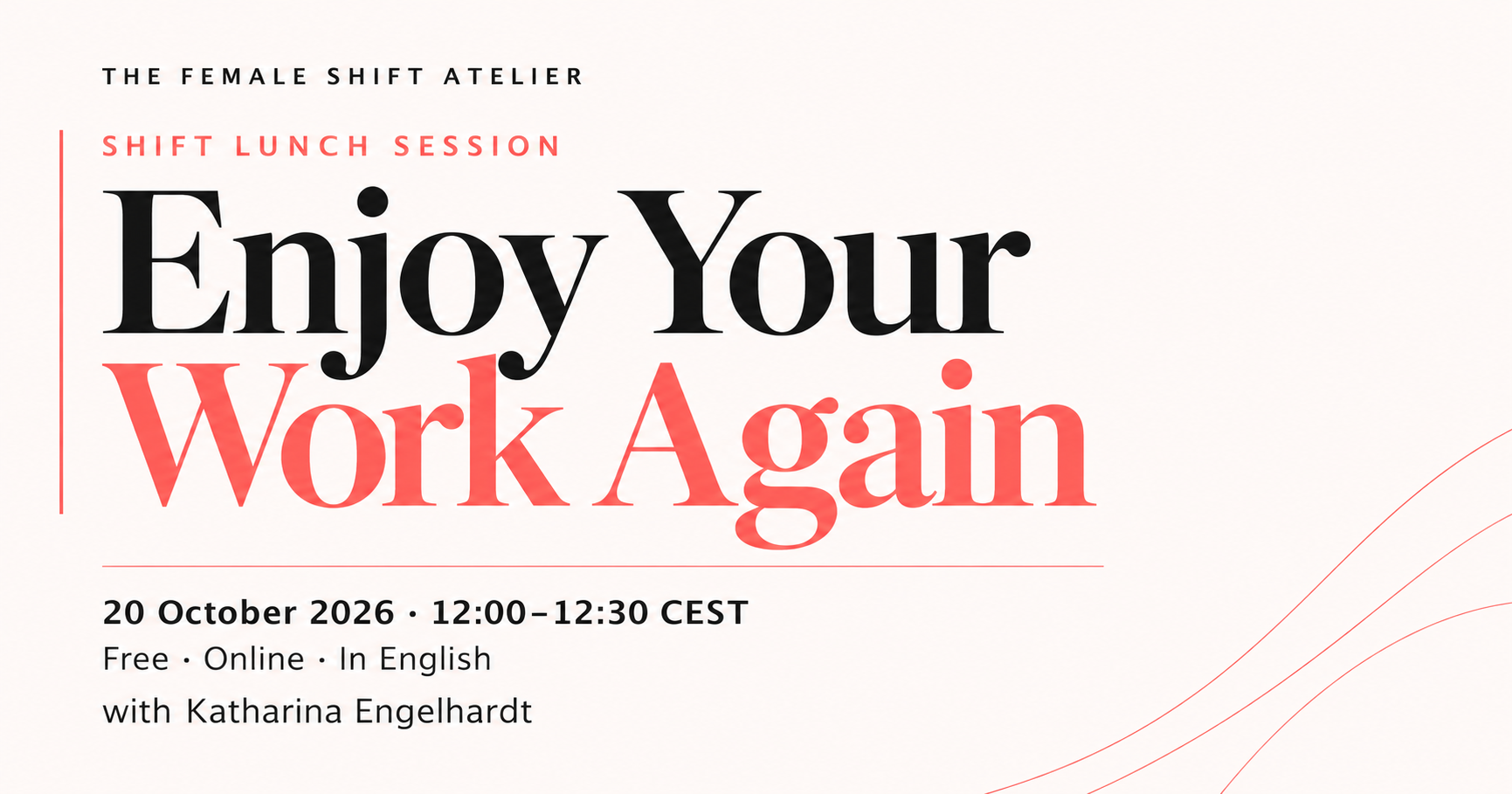
If your calendar shows a growing gap between what you deliver and what you need to enjoy and shape your work, join my free SHIFT Lunch Session, Enjoy Your Work Again, on Tuesday, 20 October 2026, from 12:00 to 12:30 Berlin time (CEST). We will use a practical Work Fit Check to name what has changed, explore what you need more of now and choose one small experiment for the following week. Join the free SHIFT Lunch Session here
Sources:
Microsoft (23 April 2025). “2025: The year the Frontier Firm is born.”
Microsoft WorkLab (17 June 2025). “Breaking down the infinite workday.”
Babcock, L., Recalde, M. P., Vesterlund, L., & Weingart, L. R. (2017). “Gender Differences in Accepting and Receiving Requests for Tasks with Low Promotability.” American Economic Review, 107(3), 714–747.
Pin this graphic if you liked the post.

Kathrina Engelhardt shares strategic questions females in the workplace
should ask more often