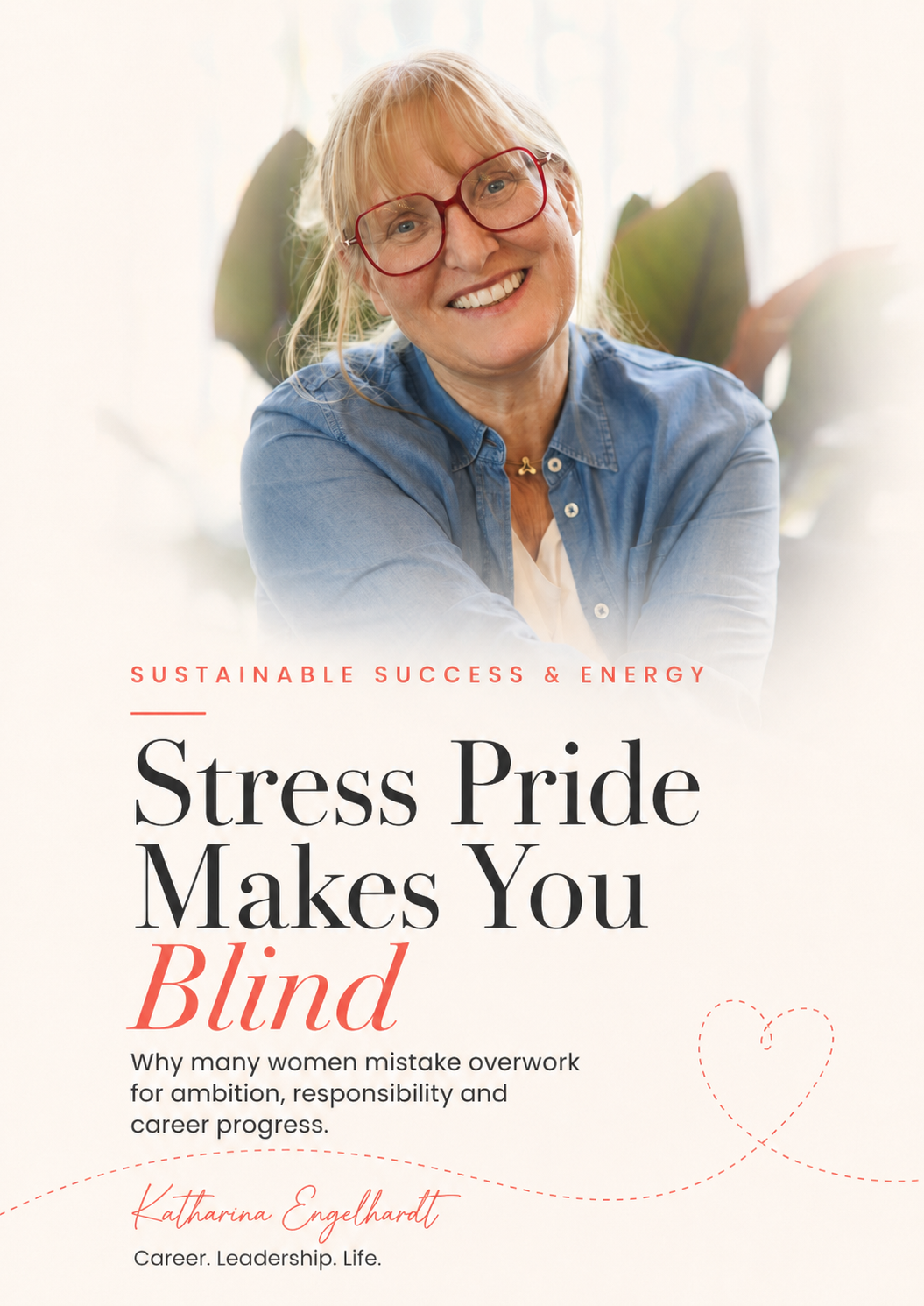
Stress Pride Makes You Blind
Why many women mistake overwork for ambition, responsibility and career progress.
This article belongs to my series “The New Cut for Women´s Careers” a series about careers in a changing world of work: visibility, strengths, influence, energy and sustainable success. Not as another layer of self-optimisation, but as a new form of professional future-readiness.
She does not say, “I am overworked.”
She says, “It is just a busy phase.” and, “There is a lot going on right now.” and, “That is what the role requires.” and, “People rely on me.” And sometimes she says it with a certain kind of pride, because being stretched has started to feel like proof that she matters. This is where stress pride becomes dangerous. Not because ambition is wrong, and not because responsibility is a problem, but because many women have learned to read overwork not as a warning sign, but as evidence of value. The full calendar becomes proof of importance. The late message becomes proof of commitment. The tired face becomes proof that she is carrying something significant. And the sentence “I have so much on my plate” begins to sound less like a signal for help and more like a badge of belonging. I understand why this happens.
Many women have built their careers by being reliable, available, prepared, helpful and strong under pressure. They have learned to carry complexity without making it look too heavy, to hold families and teams together, to anticipate what others miss and to step in before something breaks. This can create a powerful professional identity: I am the one who gets things done. I am the one who can handle it. I am the one people trust when it becomes difficult. But a career that only works when you are permanently stretched is not a good fit.
It may look impressive from the outside. It may even receive applause. But if it only works when you ignore your limits, silence your own needs and turn exhaustion into a proof of ambition, then we need to take a closer look at the cut. A garment that only looks good while you stand still, but restricts every real movement, is not well designed. And a version of success that only works when you stop noticing your own limits is not sustainable leadership.
When everything comes together, overwork stops feeling unusual.
For many women, overwork does not arrive as one dramatic moment. It arrives as accumulation. One more project, one more reorganisation, one more difficult stakeholder, one more leadership expectation, one more school email, one more care responsibility, one more parent who needs support, one more health symptom that is easy to ignore, one more private conversation that happens too late in the evening because there was no other space left in the day.
This is the rush hour of life: The phase where career, family, partnership, care work, health, money, ageing parents, children or teenagers, ambition, identity and the question “What do I actually want next?” often collide. It is not one single stressor that becomes too much. It is the simultaneity. It is the fact that everything seems to matter at the same time, and every area of life has a very good reason why it cannot wait. That is why many women do not realise they have crossed a line. The line has become covered by laundry, leadership meetings, Teams messages, care appointments, restructuring updates, school logistics and the quiet emotional labour of making sure everybody else is mostly okay.
The data shows that this is not just a feeling. In Germany, women still carry significantly more unpaid care work than men. The Federal Ministry for Family Affairs reports a Gender Care Gap of 43.4%, meaning women spend around 76 minutes more per day on unpaid care work than men; men spend just under 20 hours per week on unpaid care work, while women spend almost 29 hours. The Federal Statistical Office reported a similar figure for 2022: Women performed around 9 hours more unpaid work per week than men. When children are involved, the gap becomes even more visible. In couple households with children, mothers perform around two and a half hours more care work per day than fathers, according to a BMFSFJ dossier on care work.
This matters for career conversations because the woman sitting in the leadership meeting is rarely only sitting in the leadership meeting. She may also be the person holding the family calendar in her head, noticing the emotional temperature at home, tracking health appointments, managing birthdays, remembering who needs new shoes, sensing when a teenager is unusually quiet, and wondering whether her own tiredness is just a phase or something she should finally take seriously. If this is the background music of life, overwork can stop feeling exceptional. It simply becomes the water she swims in.
When “having it all” becomes carrying it all
For a long time, “women can have it all” sounded like a promise of freedom. It suggested that women should not have to choose between career and family, ambition and love, leadership and real life. And as an idea, I still understand the longing behind it. Of course, women should be allowed to want more than one thing. Of course, ambition does not cancel motherhood. Of course, leadership and care should not be treated as mutually exclusive. But somewhere along the way, “having it all” became suspiciously close to “carrying it all.”
The promise shifted from possibility to performance. You can have a career, children, partnership, health, friends, ageing parents, personal growth, emotional availability, a beautiful home, strong boundaries, a good body, meaningful work and a calm nervous system. Wonderful. And if you cannot hold all of it with grace, perhaps you simply need a better routine, a clearer mindset, a new planner, more confidence, stronger boundaries and maybe a smoothie with protein powder.
This is where the narrative becomes dangerous. It turns a structural overload into an individual challenge. It makes women feel proud of busyness because busyness becomes the visible evidence that they are managing the impossible. She is not just working late; she is proving she can be ambitious and responsible. She is not just exhausted; she is proving she can handle her role and her life. She is not just always available; she is proving she can have it all.
The problem is not that women wanted too much. The problem is that the promise of having it all was too often translated into women carrying it all. And once carrying becomes part of identity, stopping can feel like failure.
When culture rewards the stretch
Stress pride does not grow in isolation. It grows fastest in cultures where overload is not treated as a warning sign, but as evidence of commitment. In many corporate environments, a full calendar still looks important. Late replies still look dedicated. Being in every meeting still looks collaborative. Taking on one more thing still looks like leadership potential. The person who never has time is often read as central, in demand and valuable, while the person who protects time for thinking may still be treated as a little suspicious, as if focus were a luxury rather than a condition for good work.
Research by Silvia Bellezza, Neeru Paharia and Anat Keinan shows that busyness and lack of leisure can function as status symbols, especially in knowledge-work cultures where being overworked signals that a person is in demand. This explains why stress can become socially rewarding. Overload does not only hurt. It also communicates something: I am needed here. I am relevant. I am important enough to be overwhelmed. The problem is that a status signal is not the same as sustainable success.
There is also a relational cost. Research on “stress bragging” published in Personnel Psychology suggests that people who boast about their stress can be perceived by colleagues as less warm and less competent, and that stress bragging can also contribute to stress contagion in teams. The point is not that people should hide their workload or pretend everything is fine. The point is that a culture where stress becomes a badge of honour does not create better leadership. It creates a room full of people silently competing over who is closer to collapse.
A toxic or psychologically unsafe culture can deepen this pattern. The American Psychological Association’s 2024 Work in America report found that 15% of workers described their workplace as toxic; APA’s psychological safety analysis links toxic workplaces with lower psychological safety and highlights the role of workplace culture in mental health. In such environments, overwork may no longer feel optional. It can feel like self-protection. If the culture rewards the stretched person, the calm person looks less committed. If boundaries are punished, availability becomes strategy. If saying no risks being labelled difficult, then yes becomes the safer word, even when it slowly empties the person saying it.
When uncertainty turns overwork into insurance
There is another reason this topic feels so urgent now: The labour market feels less stable for many people. Restructuring, layoffs, cost pressure, AI, automation and role redesign all create a subtle form of background anxiety. Even when nobody says it openly, many employees feel the question: Am I still needed? Is my work still relevant? Will my role still exist? What happens if the tasks I built my reputation on become automated, reduced or reorganised?
The World Economic Forum’s Future of Jobs Report 2025 notes that employers expect AI and information-processing technologies to have major effects on jobs and skills; the WEF also reports that 40% of employers anticipate reducing their workforce where AI can automate tasks. This does not mean that everyone should panic, and it does not mean that AI is only a threat. But it does mean that uncertainty becomes part of the emotional reality of work. And in uncertainty, overwork can start to feel like insurance.
If I do more, maybe I will be safer. If I stay visible through workload, maybe I will seem indispensable. If I answer faster, take on more, show up everywhere and prove I can still carry a lot, maybe nobody will question my value.
This is one of the quieter mechanisms behind stress pride. It is not always pure ambition. Sometimes it is fear dressed as commitment. And because many women have already learned to prove their value through performance, uncertainty can push them deeper into the old pattern: do more, carry more, be more useful, become harder to ignore. But in a changing world of work, being constantly busy is not the same as being future-ready. It may even prevent the work that future-readiness requires: learning, reflecting, repositioning, building visibility, updating skills, protecting energy and asking what kind of value should define the next chapter.
The younger generation is questioning the badge of busyness
This is where the perspective of younger generations becomes interesting. Deloitte’s 2026 Gen Z and Millennial Survey reports that only 6% of Gen Zs and millennials say achieving a leadership position is their primary career goal. Only 25% of Gen Zs and 21% of millennials prefer fast-paced career progression through rapid promotions; many prefer gradual growth or lateral moves that build experience and long-term success. Deloitte also notes that many associate leadership roles with well-being tradeoffs.
I do not read this as proof that younger generations lack ambition. I read it as a sign that many people are becoming more suspicious of old career symbols. A title alone is not enough if the role comes with permanent overload. A promotion is not attractive if it looks like less life, less health and more pressure to perform an outdated version of leadership. A leadership path loses credibility if everybody at the top looks exhausted, unavailable or quietly unhappy.
Younger generations may not be rejecting ambition. They may be rejecting the performance theatre around ambition. And perhaps women in mid-career should listen carefully to that. Not because every younger trend is automatically wisdom in sneakers, but because the question is valid: If success requires permanent exhaustion to be credible, what exactly are we calling success?
Why women are especially vulnerable to stress pride
This is not a biological argument. It is a system argument. Women are often rewarded for the very behaviours that make stress pride more likely: being reliable, helpful, emotionally aware, prepared, available, collaborative and willing to carry what others overlook. These are strengths, but in the wrong conditions they can become traps. Responsibility becomes over-responsibility. Empathy becomes emotional labour. Reliability becomes permanent availability. Excellence becomes overdelivery. And being needed becomes a substitute for being recognised.
Research by Linda Babcock, Maria Recalde, Lise Vesterlund and Laurie Weingart shows that women are more likely than men to be asked to take on, volunteer for and accept tasks with low promotability, a work that helps the organisation but does not necessarily advance the individual’s career.
This matters deeply for the stress pride conversation, because many women are not only working too much. They are working too much on things that create appreciation without necessarily creating authority, visibility or career movement. They become the person who holds everything together. But holding everything together is not the same as leading. Being needed is not the same as being sponsored. Being trusted with more work is not the same as being seen for the next opportunity.
This is where stress pride becomes a career fog. It can make a woman feel important while slowly moving her further away from the work that would actually position her.
When overwork becomes identity
At the psychological level, overwork can become more than a time problem. It can become an identity contract.
If I perform, I am safe. If I deliver, I belong. If I am needed, I matter. If I am exhausted, I have proof that I am giving enough. And if I stop, what remains?
This is why rest can feel strangely uncomfortable for high-achieving women. Not because they dislike rest, but because rest removes the evidence. When performance has become the currency of self-worth, quiet can feel like losing value. A free hour can feel suspicious. A boundary can feel selfish. A no can feel like a threat to belonging. And a week without visible strain can feel as if one is no longer doing enough.
This is also why “just set better boundaries” is often too small as advice. Of course boundaries matter. But if a woman’s sense of safety, value and identity has become entangled with being needed, the boundary is not only a calendar decision. It is an identity shift. She is not only asking, “Can I decline this meeting?” She is asking, often without knowing it, “Will I still matter if I carry less?”
Engagement is not overextension
This is where we need to separate two things that are often confused. Engagement and overextension can look similar from the outside. Both can involve effort, energy, responsibility and commitment. But internally, they are very different. Engagement has direction. Overextension has pressure. Engagement gives energy back, at least over time. Overextension slowly empties the system. Engagement is connected to meaning, choice and impact. Overextension is often connected to fear, proving and the inability to stop. Engagement can coexist with recovery. Overextension treats recovery as a threat to productivity. The WHO describes burnout as an occupational phenomenon resulting from chronic workplace stress that has not been successfully managed, with three dimensions: exhaustion, mental distance or cynicism, and reduced professional efficacy. Long working hours are also not a harmless badge of ambition. WHO and ILO estimates found that long working hours led to 745,000 deaths from stroke and ischemic heart disease in 2016, and the ILO notes that working at least 55 hours per week is associated with higher risks of both conditions compared with 35–40 hours per week.
This is not a call for fear. It is a call for honesty. A woman who is permanently overextended is not proving that she is strong. She may be proving that the system around her is poorly designed, that the expectations on her are unsustainable, or that she has been rewarded for ignoring her own limits for too long. Sustainable success is not built on permanent stretching. It is built on energy that can hold, focus that can deepen, work that creates real value, and leadership that does not require self-erasure.
Seven warning signs of stress pride
You may be caught in stress pride if you talk more often about how full your calendar is than about what your work is actually creating. You may be caught in stress pride if rest feels less like recovery and more like guilt, emptiness or the fear of falling behind. You may be caught in stress pride if being needed gives you a stronger sense of value than being strategically visible. You may be caught in stress pride if you say yes before you have even checked whether the request belongs to your role, your priorities or your future. You may be caught in stress pride if exhaustion has become part of how you explain your ambition. You may be caught in stress pride if you are doing a lot, carrying a lot and solving a lot, but not actually becoming more recognised, more influential or more free. And you may be caught in stress pride if you feel proud of how much you endure, but no longer feel much joy in what you are building.
These warning signs are not there to shame you. They are there to give you language. Because the moment you can name the pattern, you no longer have to confuse it with your personality.
The Stress Pride Check
If this article touches something in you, take ten minutes and ask yourself a few honest questions.
What do I secretly take pride in that is actually draining me?
Where do I use exhaustion as proof that I matter?
Which work makes me needed but not more visible?
What am I afraid would happen if I stopped carrying so much?
Which part of my overwork belongs to my ambition, and which part belongs to fear, habit or culture?
Where has “having it all” quietly become “carrying it all”?
And what would sustainable ambition look like if it did not require me to be permanently stretched?
The point is not to answer perfectly. The point is to interrupt the automatic story. Because stress pride thrives when overwork remains unnamed.
The Female Shift
The next level of leadership is not proving how much you can carry. It is deciding what should no longer be carried by you. That does not mean becoming less ambitious. It means becoming more precise about what deserves your ambition. It means understanding which work creates value, which work creates visibility, which work belongs to you, which work belongs to the system, and which work you have simply carried because at some point people learned that you would. This is where SHIFT and FLOW come in. SHIFT is about moving from reaction to conscious self-leadership: clarity, energy, courage, productivity, influence and the inner architecture to lead without losing yourself. FLOW is about building a way of working that uses your strengths more naturally, so success feels lighter, more sustainable and more like you.
Because the answer to stress pride is not to stop caring. It is to stop confusing overextension with value. A career that only works when you are permanently stretched may look impressive from the outside, but it is not a good cut. It does not move with you. It does not breathe with your life. It does not protect your energy or your future.
And if it only fits when you stand still and hold your breath, maybe the problem was never your body. Maybe the cut was wrong.
Closing
I am Katharina Engelhardt, founder of The Female Shift Atelier. I help high-achieving women shift from performing to leading so success holds up over time and feels good.
This article is part of my series “The New Cut for Women’s Careers” a series about the patterns, skills and systems that shape women’s careers in a changing world of work. If this article made you recognise your own stress pride, stay close. In the next pieces, I will continue exploring how women can build careers with more clarity, visibility, influence, energy and choice not by carrying more, but bay taking new measure.
Because sustainable success does not ask you to prove how much you can endure. It asks what kind of success can actually move with your life.
Stay courageous, Katharina
Ready for your own SHIFT?
If this article made you realise that you are doing a lot, but not always focusing on the work that creates recognition, visibility and long-term career value, I would love to invite you to a 30min free clarity call. Book the free Clarity Session here.
Sources
American Psychological Association. (2024). Work in America Survey / Psychological safety in the changing workplace.
Babcock, L., Recalde, M. P., Vesterlund, L., & Weingart, L. (2017). Gender Differences in Accepting and Receiving Requests for Tasks with Low Promotability. American Economic Review.
Bellezza, S., Paharia, N., & Keinan, A. (2017). Conspicuous Consumption of Time: When Busyness and Lack of Leisure Time Become a Status Symbol. Journal of Consumer Research.
BMFSFJ. (2024). Gender Care Gap — ein Indikator für die Gleichstellung.
Deloitte. (2026). Gen Z and Millennial Survey 2026.
ILO / WHO. (2021). Long working hours can increase deaths from heart disease and stroke.
Microsoft. (2025). Work Trend Index 2025.
World Economic Forum. (2025). Future of Jobs Report 2025.
World Health Organization. (2019). Burn-out an occupational phenomenon.
Pin this graphic if you liked the post.