When a Strengths Profile Reveals More Than a Job Title
What can you see about a person if you know nothing about their CV, their role, or their career history only their strengths?
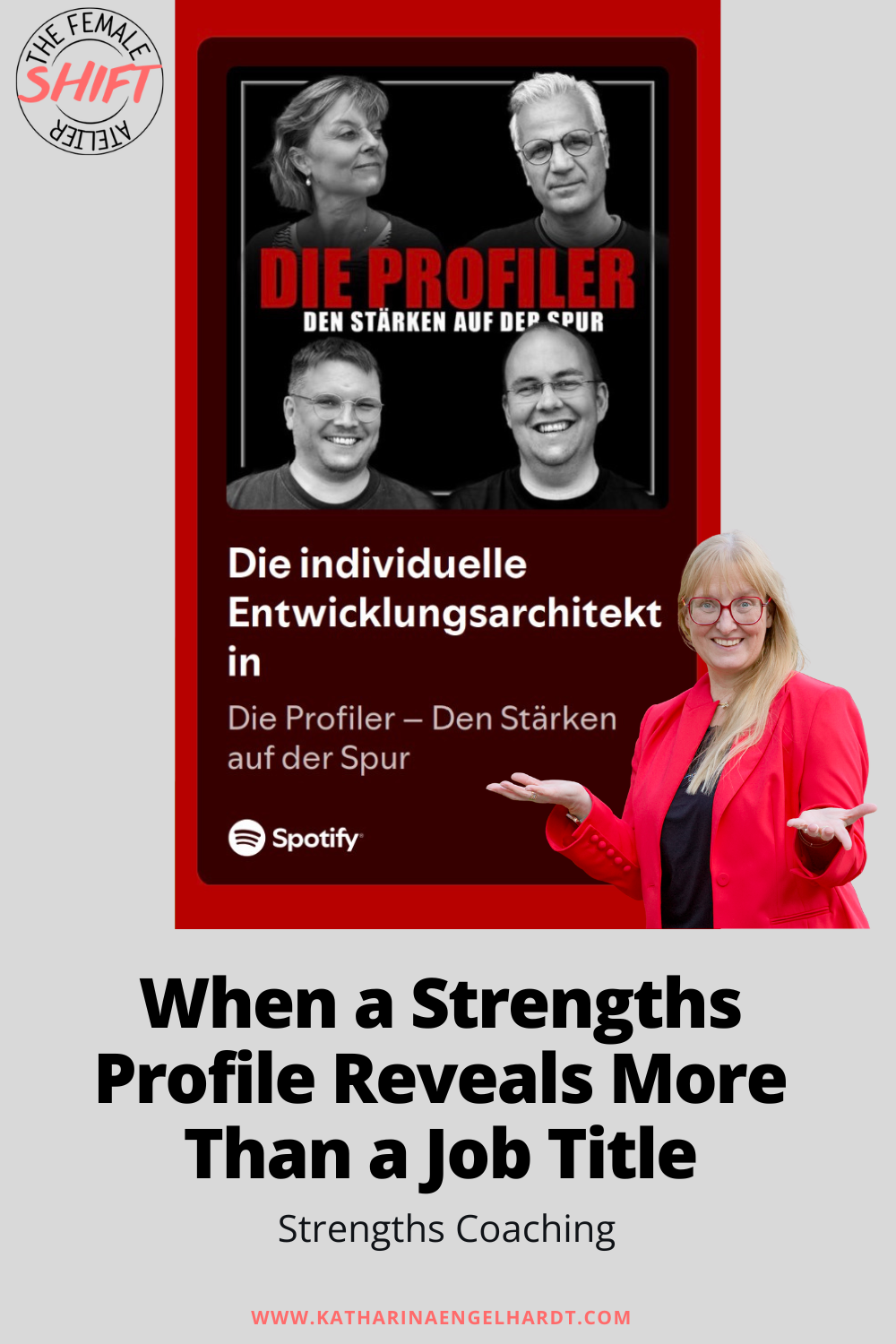
That was exactly the premise of a recent strengths discussion based on my CliftonStrengths 34 profile. A group of experienced coaches analyzed the pattern of my top talents without knowing who the profile belonged to. What emerged was both fascinating and affirming: They identified a person who combines individual focus, problem-solving, future thinking, and strong implementation energy but in a quieter, more tailored, and less conventional way than many leadership stereotypes would suggest.
For me, that is exactly why strengths work is so powerful. It helps us move beyond labels and look at the deeper patterns of how someone thinks, leads, connects, and creates impact.
What is CliftonStrengths 34?
CliftonStrengths 34 is a strengths assessment developed to identify a person’s natural patterns of thinking, feeling, and behaving. Rather than focusing on deficits, it highlights where energy comes more naturally, how someone tends to create results, and what kind of contribution they are most likely to make when they are working at their best.
The full 34-profile gives a broad and nuanced view. It does not only show what is most visible on the outside. It also reveals tensions, combinations, and hidden dynamics that often explain why someone may look very different from the usual picture of “leadership potential” or “career success.”
That is where the real value begins.
The profile: Individual, Strategic, Future-focused
My own profile starts with the following top strengths: Individualization, Arranger, Learner, Achiever, Restorative, Ideation, Futuristic, Relator, Developer, and Activator. In the discussion, the coaches quickly picked up on a rare combination: Someone who sees people deeply, understands what they need, thinks ahead, solves problems, and gets things moving.
What made the profile especially interesting was not only what appeared at the top, but how the pattern came together.
The coaches noticed that this is not the profile of someone who naturally seeks broad attention or performs through classic extroverted communication. In fact, one of the most interesting questions in the discussion was how a person can be so strongly people-oriented while scoring much lower on talents such as communication or contact-building. Their conclusion was powerful: This is someone who does not necessarily connect through width, but through depth. Someone who notices individuals, understands them quickly, and helps them grow in a highly tailored way.
They described the profile less as that of a “loud leader” and more as a developmental architect. Someone who sees patterns, brings clarity into complexity, combines insight with structure, and helps others make progress. Someone who may not dominate the room, but who can have a profound effect on the people around them.
I found that description deeply accurate..
Why this is such a strong starting point for coaching
A strengths profile like this is not interesting because it gives you a flattering label. It is useful because it gives you a more precise map.
Many ambitious women spend years building careers based on capability, reliability, and performance, while having far less clarity on how they naturally create value, where they may be underusing their strengths, and what kind of leadership or career path actually fits who they are.
This is exactly where coaching begins to shift from abstract reflection to practical self-understanding.
When we look at a strengths profile in coaching, we are not only asking, “What are you good at?” We are asking deeper questions:
Where do you create energy instead of just spending it?
How do you influence people most naturally?
What kind of visibility fits your style instead of forcing you into someone else’s model?
Which strengths are carrying you — and which combinations may also trip you up if left unconscious?
A strong profile is not a finished answer. It is a rich starting point.
The mixing desk: Why strengths need interpretation
One of the most useful ways I work with strengths is through the image of a mixing desk.
Your strengths are not isolated traits sitting neatly next to each other. They work more like sliders on a sound desk. Some are turned up high. Others stay in the background. Some create brilliance in combination. Others can create noise, tension, or overdrive when pushed too far.
That means the goal is not to admire your Top 10 and stop there. The goal is to understand how the whole pattern plays together in real life.
For example, a combination like Individualization, Developer, and Relator can make someone exceptional at seeing and growing people one by one. Add Arranger and Restorative, and that same person may also be highly effective in solving problems and creating movement in complex situations. Add Achiever and Activator, and there is even more momentum. But without awareness, those same strengths can also lead to overextension, high internal pressure, or a style of contribution that stays highly valuable yet not always visible enough. That is where coaching becomes transformative.
Strengths for career orientation
A strengths profile can be incredibly helpful when you are rethinking your next step.
Sometimes the issue is not that you lack options. It is that your experience has become broader than your own story about yourself. You have done many things, succeeded in many environments, and still find it difficult to say clearly what kind of role, leadership style, or contribution is truly yours.
Strengths work helps bring language to that.
It can show whether you are more energized by building, leading, solving, mentoring, creating, influencing, structuring, or initiating. It can help explain why some roles look good on paper but do not feel right in practice. And it often reveals that what you thought was “just how you work” is actually a distinctive pattern of contribution that deserves to be named, owned, and positioned.
That is why strengths are not just useful for personal reflection. They are highly relevant for career orientation, transitions, reinvention, and leadership development.
Strengths for visibility
This work also matters deeply when it comes to visibility.
Many women believe visibility means becoming louder, more extroverted, or more performative. I do not believe that.
Real visibility starts when you understand what is distinctive about the way you lead, think, and create value — and when you can communicate that clearly. A strengths profile can help you do exactly that. It gives you a more grounded way to talk about your contribution, your leadership style, your edge, and the environments in which you thrive.
It helps you move from vague competence to clear positioning.
And that is often the difference between being appreciated and being truly seen.
This is the work I offer
This is exactly the kind of work I do with clients.
I help women use strengths as a practical tool for deeper self-understanding, stronger positioning, and more intentional career decisions. Together, we do not just read a profile. We interpret it. We look at the patterns, the tensions, the hidden advantages, and the places where a woman may have adapted for so long that she has lost sight of her natural way of leading.
Whether you want to understand your leadership style more clearly, prepare for a career move, strengthen your visibility, or reconnect your strengths with a version of success that actually feels sustainable, this is powerful work to begin with.
If you would like to explore your own strengths profile and what it reveals about your career, leadership, and next chapter, I offer coaching around exactly this. Book a conversation with me and let’s look at what is already in you and how to bring it forward more clearly. 👉 Click here to schedule your call.
Pin this graphic if you liked the post.