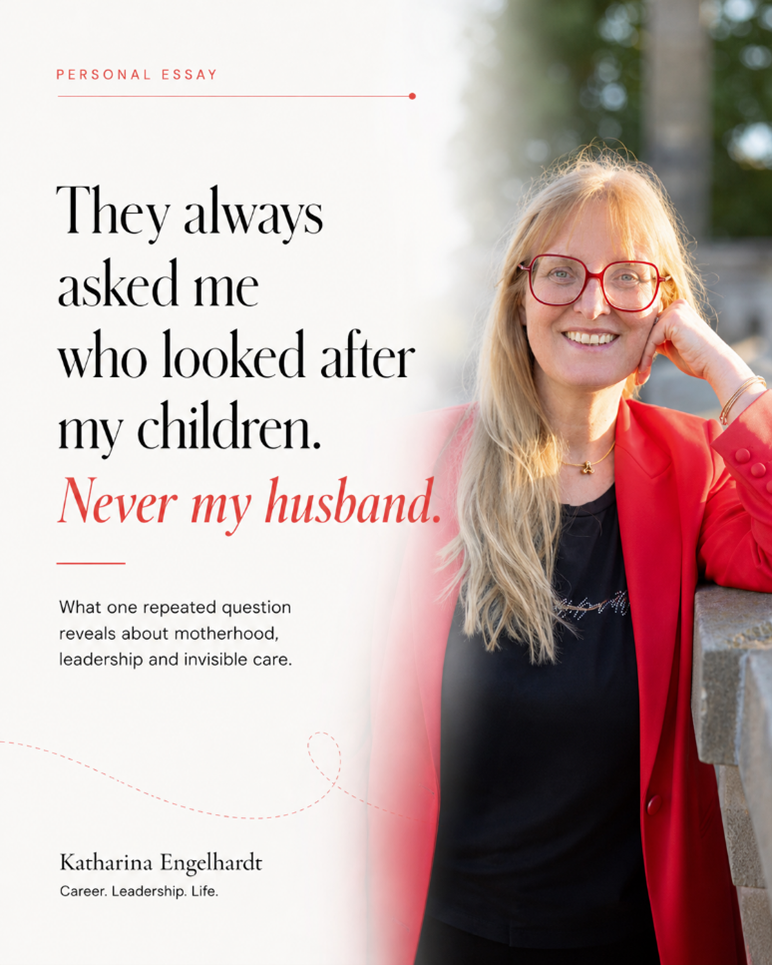
They Always Asked Me Who Looked After My Children. Never My Husband.
What one repeated question reveals about motherhood, leadership, and the career systems still built around invisible care.
For many years, whenever I travelled for work, took on responsibility, joined important meetings or showed up in demanding roles, people asked me one question again and again:
“Who is looking after your children?”
It was not asked only once. It came from different directions. HR asked. Managers asked. Peers asked. Team members asked. Sometimes it came with genuine kindness, sometimes with a little curiosity, sometimes almost like a spontaneous offer to organise babysitter services on my behalf.
And to be clear: I do appreciate kindness. I appreciate support. I appreciate people who care. But my husband was never asked. Not once in the same way.
That is the sentence that stayed with me. Not because I wanted people to stop caring about my children, but because the question revealed something much bigger than childcare logistics. It revealed an assumption: that my motherhood was something that needed to be checked, explained, organised and made professionally acceptable, while my husband’s fatherhood remained invisible in the background of his working life.
At first, I was irritated.
Later, I became almost amused by the predictability of it.
And then, over time, I became frustrated, because I realised that my mother had been asked similar questions thirty years earlier.
Different generation. Different workplace. Different decade. Same assumption. A woman’s career needs to explain where the children are. A man’s career usually does not.
The question underneath the question
On the surface, “Who is looking after your children?” sounds practical. It can even sound caring. But repeated over time, and directed almost exclusively at mothers, it becomes something else. It becomes a test.
Are you really available?
Are you really committed?
Are you really able to travel?
Are you really focused?
Are you really allowed to be here fully?
Nobody said it like that, of course. That would have been too obvious, and most bias rarely walks into the room with a name tag. It is usually more subtle. It comes as a small question, a raised eyebrow, a friendly comment, a joke, a concern, a “just checking.” But careers are shaped by these small signals. Over time, they teach women what needs to be justified. They teach mothers that their ambition is always accompanied by a footnote. And they teach everyone else that care is somehow primarily attached to the woman, even when a family has organised things differently.
My usual answer was simple. I would say that my husband and I take care of it together, that everything is organised, and sometimes, to keep it light, I would add: “If you know a good babysitter, feel free to recommend one.” And then, when it made sense, I would add the sentence that mattered most:
“Interestingly, my husband never gets asked this question.”
It was my small way of keeping the conversation warm, but not harmless. Because sometimes humour is the most elegant way to place a mirror in the room.
Motherhood was treated as a logistics risk
What I understand today is that the question was not really about my children. It was about the way motherhood is still interpreted inside many professional systems. A working mother is often seen through a double lens. Her performance may be strong, her commitment visible, her results clear but somewhere in the background there is still a quiet question: will the children interfere?
A father is often read differently. Fatherhood can even add a layer of maturity, stability and responsibility to his professional image. Motherhood, however, can still trigger assumptions about reduced ambition, limited availability or future complications.
This is not only a feeling. Research has long described what is known as the motherhood penalty: mothers can face disadvantages in pay, hiring, promotion and perceived commitment, while fathers may experience a different, often more positive, professional reading of parenthood. Harvard Business Review describes this as the contrast between the motherhood penalty and the fatherhood wage premium.
That is why the question matters. Because it is not just a question. It is a tiny piece of an old career design.
One where leadership is still too often imagined around someone who can be endlessly available because somebody else is holding the private infrastructure together.
The career model with an invisible partner
Many traditional career models were not designed around real life. They were designed around invisible support.
Someone can stay late.
Someone can travel.
Someone can relocate.
Someone can take the evening call.
Someone can attend the early meeting, the late dinner, the offsite, the urgent session, the spontaneous “can we quickly align?” that, of course, is never quick.
But behind that “someone,” there was often another someone. A partner who absorbed the domestic rhythm. A wife who kept the calendar of birthdays, school appointments, vaccinations, lunchboxes, sports shoes, teacher conversations, elderly parents and the mysterious disappearance of exactly the one item a child needs tomorrow morning at 7:15. For many men, historically, that support system was assumed. For many women, it was not. And when women entered the same career systems, the private infrastructure did not magically redistribute itself. It often stayed attached to them.
This is one reason why I believe we need to be very careful when we tell women to “lean in,” “be more visible,” or “take the opportunity” without looking at the full structure around them. Visibility is powerful. Ambition matters. Leadership matters. But if a career model only works when one partner silently absorbs the family system, then it is not a neutral model. It is a model with a hidden requirement.
This is where my work connects so strongly to the idea that availability is not leadership. In my own thought-leadership framework, I describe how constant availability is still confused with commitment and readiness, and how care is still treated as a private logistics issue rather than a structural career factor. That is exactly what this question revealed. It asked whether I could still fit into a system that had not fully adjusted to the reality that mothers also lead.
Flexibility was not a lifestyle benefit
I remember applying for permission to work from home at a time when working from home was not common. Two people from the works council came to check whether my apartment was suitable. Imagine that. Today, we discuss hybrid work as if it simply arrived one day wearing a modern leadership badge. But for many working mothers, flexibility was never a lifestyle benefit. It was not a fancy future-of-work concept. It was the infrastructure that made professional continuity possible.
And still, the request for flexibility was often interpreted as a deviation from the norm. Something that needed checking. Something that needed permission. Something that needed to be proven safe, reasonable and not too inconvenient for the system. This matters because many mothers did not step back because they lacked ambition. They stepped back because the conditions around ambition were too narrow. The issue was not always the ambition of the woman. Sometimes it was the cut of the role.
And that is a sentence I keep coming back to in my work:
Not the woman is wrong. Often the career pattern is too tight, too old, or was never designed for her life in the first place.
Children grow. Careers are long.
There is one nuance that is very important to me. I do not believe women should automatically shrink their professional decisions around one intense family phase. Children grow. Their needs change. What is difficult for two or three years may not define the next ten or twenty.
I knew that from my own childhood as well. Children can cope with more than many people assume, especially when there is love, reliability and honesty in the system around them. Family life is not one frozen stage. It changes. The need for care changes. The kind of presence children need changes. The rhythm changes. That is why I always become careful when women are encouraged to make permanent career decisions based only on the pressure of a temporary season.
Sometimes the answer is not to reduce the woman’s career.
Sometimes the answer is to redesign the support.
To renegotiate the partnership.
To question the role.
To clarify expectations.
To stop proving commitment through overavailability.
To ask whether this career shape actually fits this life phase — or whether everyone is simply trying to squeeze a real woman into an old pattern.
This is not about pretending that everything is easy. It is not. Anyone who has ever combined children, travel, leadership and a calendar held together by school notes and coffee knows that. But it is also not helpful to tell women, directly or indirectly, that motherhood is a professional warning label.
The numbers show the pattern
The personal story is one part of it. The data shows that it is not only personal. In Germany, women still do significantly more unpaid work than men. In 2022, women performed around nine hours more unpaid work per week than men, resulting in a Gender Care Gap of 44.3%.
The labour market reflects the same pattern. In 2023, 91.4% of employed fathers in Germany worked full-time, while only 27.0% of employed mothers did. For mothers, part-time work was the rule; for fathers, it remained the exception.
And the long-term career cost is significant. Reporting on a ZEW and Tilburg University study, Reuters noted that German mothers earn almost €30,000 less on average than women without children in the four years following the birth of their first child.
These numbers are not abstract. They become careers. They become pensions. They become options lost or never offered. They become the quiet shrinking of professional confidence when women start to believe that they are difficult, expensive, complicated or less available simply because they have a life beyond work.
Globally, the picture is even larger. The International Labour Organization estimates that in 2023, 708 million women worldwide were outside the labour force because of unpaid care responsibilities, compared with 40 million men.
So when one woman is asked who looks after her children, we should not treat it as a harmless question only. It belongs to a much larger pattern of how care is allocated, valued and interpreted.
Gen Z is watching
This is also why the question matters for the next generation. Younger women are watching what career seems to cost. They see senior women carrying responsibility at work and invisible logistics at home. They see companies talk about flexibility while still rewarding constant availability. They see leadership models that are often still designed around the idea that someone else will take care of everything private. And many of them are making different calculations.
Deloitte’s 2025 Gen Z and Millennial Survey reports that Gen Z is more focused on work-life balance than climbing to the top of the corporate ladder, with only 6% naming a leadership position as their primary career goal. At the same time, Deloitte emphasises that this does not mean Gen Z lacks ambition; learning and development remain highly important to them. I find this important.
Maybe younger people are not rejecting ambition.
Maybe they are rejecting a version of ambition that looks too expensive.
Maybe they are asking a very reasonable question: if leadership still requires a life model that only works when somebody else quietly holds the private system together, is that really success?
And honestly, that question deserves more than an eye roll about younger generations. It deserves a serious answer. And yes, this connects to birth rates We should be careful not to reduce declining birth rates to one single cause. That would be too simple, and life is rarely that obedient. But we should also not pretend that career design has nothing to do with it.
Germany’s total fertility rate fell to 1.35 children per woman in 2024, according to the Federal Statistical Office. Across OECD countries, fertility has also declined sharply over the decades, and the OECD explicitly states that fertility rises when women can combine work and family life on an equal footing with men. That sentence should be printed out and placed gently, but firmly, on many boardroom tables.
Because if we want young people to imagine family and career as compatible, we cannot keep building career systems that make children look like a private complication, especially for women. It is no wonder that many women hesitate.
If the message is: “You can have a career, but please make sure your children do not become visible in it,” then we should not be surprised when people begin to question the whole model. Motherhood is not the problem. The problem is a career model that still treats care as an interruption instead of part of human life.
What this does to women
The emotional cost of this is difficult to measure, but very easy to recognise. It creates a constant double awareness.
Am I committed enough at work?
Am I present enough at home?
Am I too ambitious?
Am I not ambitious enough?
Am I allowed to want more?
Am I selfish if I travel?
Am I wasting my potential if I do not?
This is not only practical pressure. It becomes identity pressure. Many women respond by overfunctioning. They work harder to prove that motherhood has not changed their commitment. They become more organised than any calendar system should legally require. They prepare more. They apologise more. They make their family life smaller in professional spaces. They prove again and again that they are “still” reliable, “still” ambitious, “still” available. That word “still” is the problem. Because no woman should have to requalify herself as a serious professional because she became a mother.
In my coaching work, I see again and again that women’s careers are shaped by an ecosystem of signals, incentives, expectations and adaptations. Some of these patterns are internal, some are relational, some are structural — and they often remain unnamed until a woman is exhausted enough to call the whole thing personal failure. That is why naming this matters. Not to blame individual people who asked a question that may have been meant kindly. But to understand what the question carried.
What needs to change
I do not think the answer is to tell mothers to become better at organising childcare. Most of them are already Olympic-level organisers. If calendar logistics were an official sport, many working mothers would have medals, sponsors and probably a hydration strategy. The answer is deeper. We need to stop treating care as a private inconvenience and start treating it as part of leadership design, talent retention and career sustainability.
That means organisations need to look at what they actually reward. Is leadership still measured through constant availability? Are stretch roles designed with real life in mind? Are fathers encouraged and expected to take care responsibilities visibly? Are mothers quietly excluded from travel, promotion or strategic projects “for their own good”? Are part-time leaders seen as less ambitious by default? Are career breaks, parental leave and flexibility still interpreted as risk markers? And women need space to ask better questions too.
Not: How do I hide the fact that I have care responsibilities?
But:
What kind of career shape fits this life phase without making me disappear?
What support do I need?
What conversations must happen at home and at work?
Which role is truly worth the energy it requires?
Where am I proving commitment through exhaustion?
Where do I need more clarity, not more guilt?
This is where coaching can help. Not because coaching can solve the structural problem alone. It cannot. Some patterns require organisational change, better management development, clearer role design and a more honest conversation about what leadership should look like today. In my framework, I make this distinction very clearly: coaching can help women recognise and shift patterns, but some career “cuts” need to be changed in the system itself. But coaching can help a woman stop making the whole pattern her personal failure.
It can help her separate temporary family pressure from permanent career identity. It can help her define what success means now. It can help her have clearer conversations with her partner, her manager, her sponsors and herself. It can help her stop translating ambition into overavailability. It can help her build a career path that fits her strengths, her energy, her leadership identity and her real life. And that, to me, is not a soft topic. It is career strategy.
The better Mother’s Day question
Mother’s Day often celebrates mothers for holding everything together. And yes, there is something beautiful in that. Mothers do hold a lot. They remember, carry, organise, feel, anticipate, repair, plan and love in ways that often remain invisible until they are missing. But this Mother’s Day, I do not only want to celebrate mothers for holding everything together. I want us to ask why so much still depends on them holding everything together in the first place.
Maybe the better question was never: “Who looks after your children?”
Maybe the better question is: “Why do we still design careers as if care belongs to someone else?”
Because the future of work cannot be built on invisible care. And women’s careers should not have to be cut smaller just because real life finally enters the room.
Closing
If this resonated with you because you are currently trying to make career, leadership and real life fit together without losing yourself in the process, this is exactly the kind of work I do in my coaching. I help women shape their career and leadership path more intentionally — with more clarity, confidence and success that fits who they are and how they want to live. Book a conversation with me and let’s look at what is already in you and how to bring it forward more clearly. 👉 Click here to schedule your call.
Sources
1. Harvard Business Review, How Biases About Motherhood Impact All Women at Work, 2024.
2. Destatis, Gender Care Gap 2022: women perform 44.3% more unpaid work than men, 2024.
3. Destatis, Parents working part time, 2023 data.
4. Reuters / ZEW and Tilburg University study, German mothers earn €30,000 less than women without children after first birth, 2025.
5. International Labour Organization, Unpaid care work prevents 708 million women from participating in the labour market, 2024.
6. Deloitte, 2025 Gen Z and Millennial Survey, 2025.
7. Destatis, Births: Germany’s total fertility rate fell to 1.35 children per woman in 2024, 2025.
8. OECD, Society at a Glance 2024, fertility and work-family compatibility.
Pin this graphic if you liked the post.