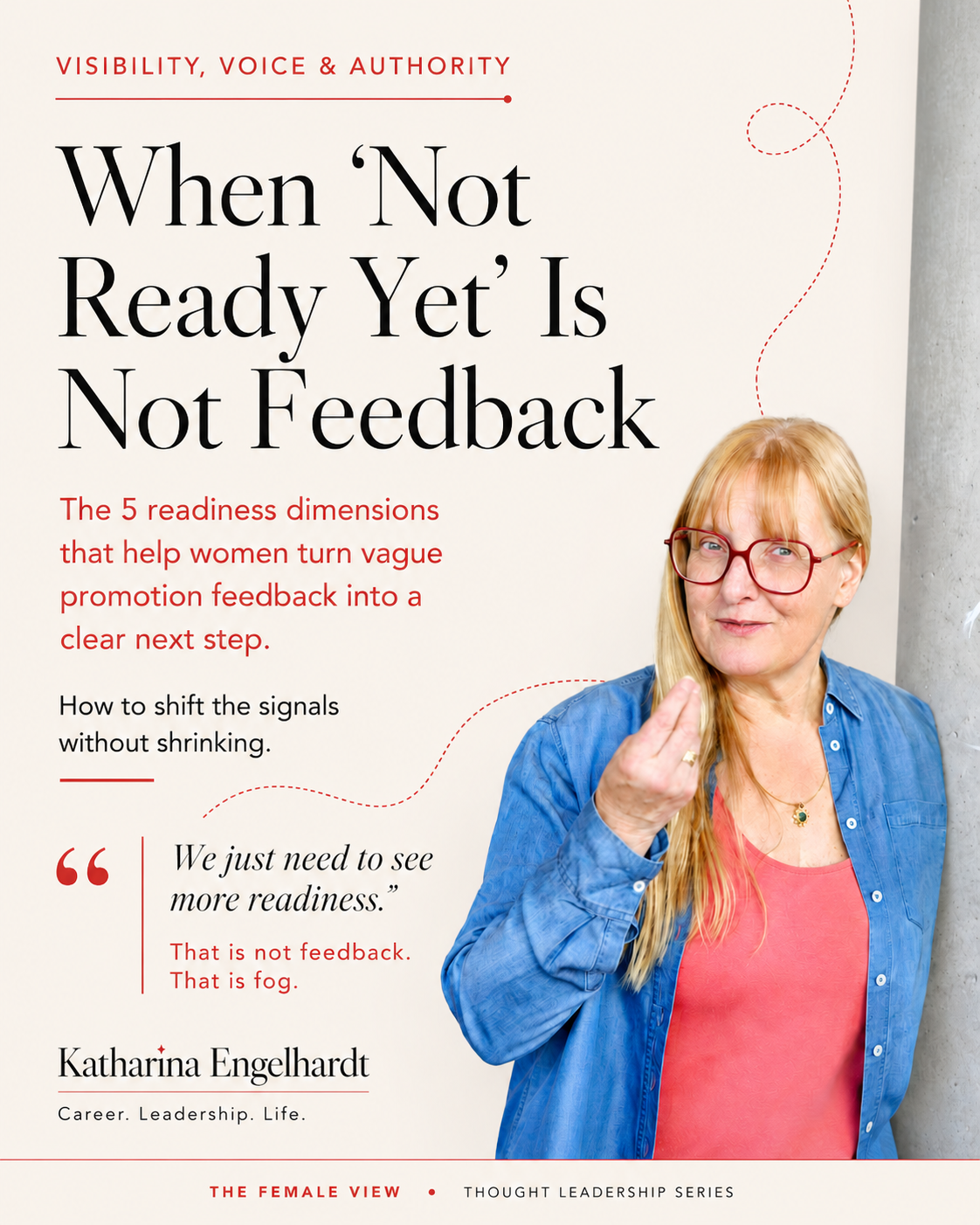
When "Not Ready Yet" Is Not Feedback
The 5 readiness dimensions that help women turn vague promotion feedback into a clear next step
This article belongs to my series “The New Cut for Women´s Careers” a series about careers in a changing world of work: visibility, strengths, influence, energy and sustainable success. Not as another layer of self-optimisation, but as a new form of professional future-readiness.
The promotion conversation that gives you nothing to work with
A woman I coached recently told me about a promotion conversation that stayed with her longer than it should have. Her manager smiled, the way people do when they honestly believe they are being supportive, and said:
"You are doing great work. We just need to see more readiness for the next level."
She nodded, because she is professional. She took notes, because she is prepared. And inside she thought: I have been ready for years. I just do not seem to be seen as ready.
That is the problem with "not ready yet." It sounds like feedback, but very often it is not feedback. It is a label. It may be meant kindly. It may even point to something real. But if nobody explains what readiness actually means, what needs to be demonstrated, who needs to see it and how it will be measured, the sentence does not create development. It creates fog.
And when feedback becomes fog, many women do what high-achieving women often do: They try to improve everything at once. They become more prepared, more polished, more available, more strategic, more confident, more visible, more diplomatic, more direct, more patient, more everything. The result is rarely clarity. It is exhaustion with better stationery.
Why vague feedback is not a small problem
Research suggests that women are more likely to receive vague, less actionable feedback that is not clearly tied to business outcomes. Shelley Correll and Caroline Simard, writing in Harvard Business Review, describe how women are less likely to receive specific feedback linked to outcomes, both when feedback is positive and when it is developmental. That matters because vague praise and vague development points do not tell a woman which behaviour to repeat, which impact to make more visible or what would change the promotion conversation next time.
This is why "not ready yet" can be so costly. It can keep a brilliant woman working harder without knowing which signal is actually missing. She may assume the gap is competence, when the real issue is positioning. She may polish her communication, when the real issue is sponsorship. She may question her confidence, when the real issue is that nobody has made her value legible in the promotion room.
The wider system also matters. Role congruity theory, developed by Alice Eagly and Steven Karau, explains that women can be perceived less favourably as potential leaders and can also be evaluated more negatively when they behave in ways associated with leadership, because those behaviours may clash with traditional gender expectations. The McKinsey and LeanIn Women in the Workplace 2025 report adds another layer: Women remain highly committed to their careers, but often receive less career support and fewer advancement opportunities than men.
So no, this is not only about confidence. And no, this is not only about bias. It is both more practical and more nuanced than that. Sometimes your readiness signal is genuinely too quiet. Sometimes it is being misread by the system. Often, it is both.
The reframe: readiness is not one thing
One reason "not ready yet" is so frustrating is that readiness sounds singular. It sounds as if there is one invisible switch somewhere inside you that has not yet flipped.
But readiness is not one thing. It is a bundle of signals.
At mid-to-senior levels, competence is usually not the whole question anymore. Of course you need to be capable. But capability alone is not always what gets evaluated. Decision makers also ask, often without saying it directly: Can she influence the informal system? Can she communicate clearly when the room is tense? Can she stay steady under pressure? Can people describe her value in a way that travels? Does she already behave like someone who belongs at the next level? Those are not soft questions. They are readiness signals.
And the useful thing about signals is this: Once you can name them, you can strengthen them. Not by becoming louder, harder or someone else, but by making your leadership easier to see, trust and sponsor. It becomes something you can focus on actively using your strengths.
The 5 Readiness Dimensions
I use five readiness dimensions with clients because they translate vague promotion feedback into something you can actually diagnose and train: micro-politics, communication, self-leadership, positioning and leadership identity. They are not a personality test. They are not a branding exercise. They are a practical way to answer the question: Which part of my readiness is strong, which part is too quiet and which part may be misread in the system I am in? In addition, every one of my clients understands their strengths based on a Clifton Strength profile and a 2hrs strength coaching (FLOW). Let´s go through the dimensions one by one to create the frame for yourself.
1. Micro-politics: Can people trust how you move through the informal system?
Micro-politics is your ability to understand the informal layer of the organisation: relationships, timing, alliances, credibility deposits and the influence that happens before and after the official meeting. It is not manipulation. It is navigation.
The missing signal often sounds like this: "She does great work, but I am not sure she has enough influence yet."
The self-check: Who would advocate for me when I am not in the room, and have I made it easy for them to do so?
One useful action: Before the next important decision, identify two stakeholders who shape the room before the room meets. Speak to them early. Share the decision, the risk and the value of your recommendation before the formal meeting becomes theatre.
Outer glass ceiling: Informal networks and sponsorship are not always distributed equally. Inner glass ceiling: Many women avoid advocacy because it feels like self-promotion or "using people." The shift is to treat relationship-building as leadership hygiene, not political contamination.
2. Communication: Can you create clarity under pressure?
Communication readiness is not about sounding polished. It is about creating clarity when the stakes rise. Senior rooms reward people who can name the decision, the trade-off, the risk and the recommendation without disappearing into detail too early or softening the message until it no longer has a spine.
The missing signal often sounds like this: "She needs to be more executive in the room."
The self-check: Do I enter important conversations with a frame, a recommendation and a trade-off — or do I wait until I have explained everything before I say what I think?
One useful action: Prepare a leadership entry line for one upcoming meeting: "The decision we need to make is... My recommendation is... The trade-off is..." It sounds simple. It changes how you are read.
Outer glass ceiling: Directness can be read differently depending on gender expectations. Inner glass ceiling: Many women over-explain to avoid being misunderstood. The shift is not to become harsh. It is to become clear earlier.
3. Self-leadership: Can you stay steady when the role gets bigger?
Self-leadership is your ability to regulate energy, attention, emotion and recovery under load. It is not wellness fluff. It is performance infrastructure. Bigger roles do not only bring more work. They bring more exposure, ambiguity, conflict and consequence.
The missing signal often sounds like this: "We are not sure how she will handle the pressure at the next level."
The self-check: When the week becomes messy, do I become clearer — or more reactive, rigid and depleted?
One useful action: Identify one recovery boundary that protects your leadership quality, not only your private life. For example: No strategic decision-making after a certain hour, protected preparation time before key meetings or a weekly review of energy leaks.
Outer glass ceiling: Many systems still reward constant availability as if it were leadership maturity. Inner glass ceiling: Many high-achieving women confuse endurance with ambition. The shift is to treat recovery as part of leadership, not as a treat after suffering.
4. Positioning: Can decision makers name your value?
Positioning is the translation layer between what you do and what the system understands. It is not bragging. It is making your value legible. If decision makers cannot quickly describe what you are known for, what impact you create and what you want next, your work may be true but not travel.
The missing signal often sounds like this: "She does a lot, but I am not sure what her next-level story is."
The self-check: If I were not in the room, could the right people explain my impact in one or two sentences?
One useful action: Create a monthly impact recap that links work to outcomes, decisions, risks reduced, revenue protected, speed created, people developed or strategic learning. The point is not to list tasks. The point is to make your value repeatable.
Outer glass ceiling: Credit can be uneven, and women’s achievements are often absorbed into team effort. Inner glass ceiling: Many women are allergic to self-promotion because it has carried social risk. The shift is to position factually, business-first and consistently.
5. Leadership identity: Have you claimed the next level before the title arrives?
Leadership identity is the internal claim that makes your external behaviour coherent. It is the sense of: This is what I stand for, this is how I lead, this is the responsibility I am willing to occupy. Without identity, you can have skills and still behave as if you are waiting to be chosen.
The missing signal often sounds like this: "She has potential, but I do not yet see her fully stepping into the next level."
The self-check: Where am I still behaving like a very capable applicant for the next role instead of a leader already practising the standards of that role?
One useful action: Write your leadership claim in one sentence: "As a leader, I stand for..." Then identify one situation this week where that claim must become visible in behaviour, not only in intention.
Outer glass ceiling: Leadership is often granted through social proof and sponsorship, not only earned through hard work. Inner glass ceiling: Many women wait for permission to claim leadership. The shift is to claim leadership consciously — not loudly, but clearly.
Your personal 5D Readiness Radar
Here is the practical part. If you have received vague feedback like "not ready yet," do not try to improve everything at once. Rate each readiness dimension from 1 to 5 based on what is true in your current system, not in your ideal world.
1. Micro-politics:
Readiness Question: Do I have people who advocate for me when I am not in the room, and do I build alignment before decisions?
2. Communication:
Readiness Question: Do I speak early with frames, questions and recommendations under pressure?
3. Self-leadership:
Readiness Question: Do I protect my energy and attention enough to stay steady when stakes rise?
4. Positioning:
Readiness Question: Can decision makers name my impact, value and aspiration clearly?
5. Leadership identity:
Readiness Question: Do I lead like the next level, or am I still waiting to be chosen?
After you rate yourself, ask one more question: Is my weakest score a skill gap, a signal gap or a system gap?
A skill gap means you need practice or capability building. A signal gap means you may already have the capability, but the right people do not see it clearly enough. A system gap means the context is distorting, blocking or undervaluing the signal. These three gaps require different strategies. That is why guessing is expensive.
The 10-minute Readiness Claim
The goal of this exercise is to turn vague feedback into a visible 30-day action. Use it before a performance review, promotion conversation or stakeholder 1:1.
Step 1: Choose your lowest readiness dimension. Not because you are failing, but because that is where the leverage is.
Step 2: Write one Readiness Claim using this sentence:
"In the next 30 days, you will see me strengthen [dimension] by doing [visible behaviour], so that [business outcome]."
Examples:
"In the next 30 days, you will see me strengthen positioning by sending a monthly impact recap tied to business outcomes, so my work is visible at the right level."
"In the next 30 days, you will see me strengthen communication by entering key meetings with a recommendation plus trade-off, so decisions move faster and with more clarity."
"In the next 30 days, you will see me strengthen micro-politics by setting two pre-alignments with critical stakeholders, so we reduce late-stage resistance."
Step 3: Ask for the proof point. Use this question with your manager or sponsor: "What would you need to see in the next 30 days to consider this dimension stronger?"
This is where vague feedback starts to become useful. Not because the system suddenly becomes perfect, but because you stop accepting fog as a development plan.
You can influence readiness without becoming someone else
This is the most important point. The goal is not to become louder, harder or less yourself. The goal is to make your leadership signals clear enough that your capability can be seen, trusted and sponsored.
You do not need to perform leadership as a costume. You need to understand how your leadership is being read. You need to know which signals are strong, which are quiet and which are being distorted by the system. Then you can decide your next move with more precision.
That is where coaching can help. When feedback is vague, it is difficult to diagnose your own pattern from inside the pattern. You may keep working on confidence when the real issue is positioning. You may keep improving communication when the real issue is micro-politics. You may keep proving competence when the real issue is leadership identity.
In my programthe Strengths Sprint 5D, we map your readiness through your strengths, your value story and your real role context. We look at what already works, what is underused, what is being misread and which readiness dimension will unlock your next step fastest.
If the question is broader than promotion readiness — if you are also asking what kind of role, direction or career form fits the woman you are becoming, my program CREATE is the deeper space to explore that.
A reflection for your own career
"Not ready yet" is not a development plan. It is a prompt to ask better questions.
What exactly is missing? Which signal is quiet? Which signal is being misread? Who needs to see it? What would good look like in the next 30 days?
You may already be more ready than the feedback suggests. But readiness that is invisible, unsupported or unclear is hard for a system to promote. The shift is not to become someone else. The shift is to make your leadership easier to see.
Stay courageous,
Katharina
Ready for your own SHIFT?
If this article made you realise that you are doing a lot, but not always focusing on the work that creates recognition, visibility and long-term career value, I would love to invite you to a 30min free clarity call.
Book the free Clarity Session here:
https://calendly.com/katharinaengelhardt/career-clarity-call
Sources
Correll, Shelley J., and Caroline Simard. 2016. "Research: Vague Feedback Is Holding Women Back." Harvard Business Review. https://hbr.org/2016/04/research-vague-feedback-is-holding-women-back
Eagly, Alice H., and Steven J. Karau. 2002. "Role Congruity Theory of Prejudice Toward Female Leaders." Psychological Review, 109(3), 573–598. PubMed summary: https://pubmed.ncbi.nlm.nih.gov/12088246/
Heilman, Madeline E., and Tyler G. Okimoto. 2007. "Why Are Women Penalized for Success at Male Tasks?" Journal of Applied Psychology.
LeanIn.Org. 2026. "The Broken Rung: Lean In Factsheet." https://leanin.org/broken-rung
LeanIn.Org and McKinsey & Company. 2025. "Women in the Workplace 2025: Key Findings and Takeaways." ttps://leanin.org/women-in-the-workplace
McKinsey & Company. 2025. "Women in the Workplace." https://www.mckinsey.com/capabilities/people-and-organizational-performance/our-insights/women-in-the-workplace
Rudman, Laurie A. 1998. "Self-Promotion as a Risk Factor for Women: The Costs and Benefits of Counterstereotypical Impression Management."
Rudman, Laurie A., Corinne A. Moss-Racusin, Julie E. Phelan, and Sanne Nauts. 2012. "Status Incongruity and Backlash Effects."
Pin this graphic if you liked the post.