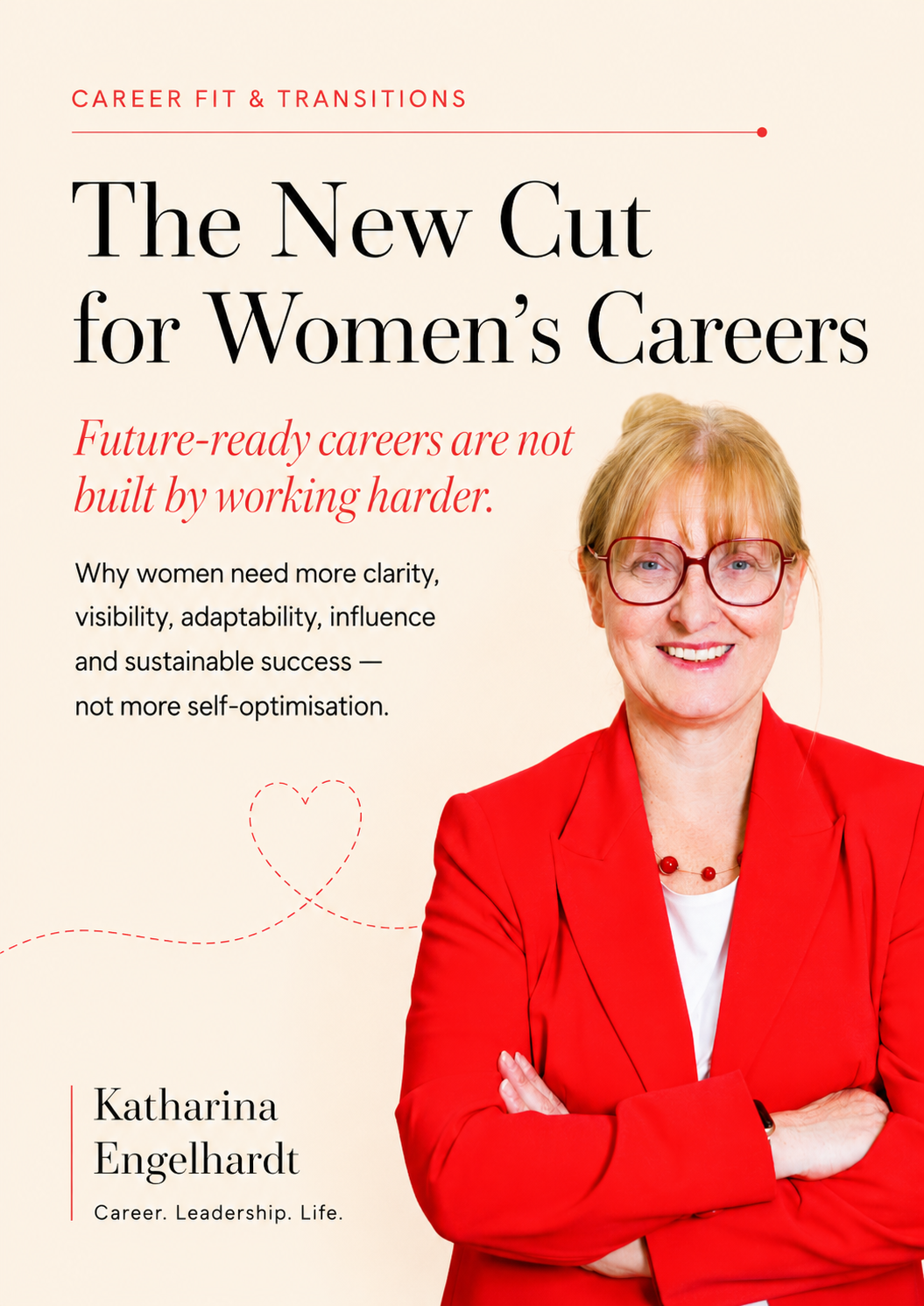
The New Cut for Women’s Careers
Why future-ready careers are not built by working harder, but by becoming clearer, more visible, more adaptable and more intentional about your value.
This article belongs to my series “The New Cut for Women´s Careers” a series about careers in a changing world of work: visibility, strengths, influence, energy and sustainable success. Not as another layer of self-optimisation, but as a new form of professional future-readiness.
There is a quiet question I hear from many women in corporate careers, and it rarely sounds dramatic at first. It often comes after a long description of a full role, a demanding team, a complex project, a performance review, a restructuring, a new AI tool, a leadership change or simply another week in which she has done what she has always done: delivered, adapted, supported, solved, prepared, responded and held things together. Then, somewhere beneath the competence, comes the question: “I have done everything right. So why does it still feel as if the future is not fully in my hands?”
This question matters because many women are not standing at the edge of the future unprepared. They are often highly capable, deeply experienced and remarkably good at making work work. They have learned to be reliable in systems that were not always reliable in return. They have learned to stay useful through change, to remain professional in ambiguity, to carry complexity without making too much noise, and to adapt to leadership cultures that were rarely designed around their strengths, energy or real lives. For many years, that kind of performance created trust, reputation and progress. But it also trained women into a career logic that is becoming too narrow for the world of work ahead.
When people talk about employability, the conversation often becomes strangely mechanical. It turns into a list of skills, certifications, tools, AI literacy, networking tactics, CV updates and reminders to stay relevant. All of those matters, of course. We do need to learn. We do need to adapt. We do need to understand the technologies and systems changing work around us. But for women, the question of future-readiness goes deeper than adding another skill to an already overfilled professional wardrobe. The more important question is whether the value women already create is visible, transferable, recognised, sponsored and connected to future options.
That is why I believe we need a new cut for women’s careers. Not another attempt to make women fit more elegantly into old patterns of performance, availability, adaptation and constant proving. Not another development plan that quietly says: please become a little more confident, a little more strategic, a little more resilient, and ideally do all of this without disturbing the room too much. A new cut means looking differently at what makes a career future ready. It asks whether a woman is simply becoming more useful to the system, or whether she is becoming more intentional about her value, visibility, strengths, energy and choices.
The old career cut is becoming too narrow
For decades, many women learned to build careers through a very specific kind of performance. They learned to be excellent, prepared, reliable and adaptable; to do the extra work, read the room, stay gracious under pressure, and prove readiness through repeated delivery. They learned to be visible enough to be considered, but not so visible that they became uncomfortable for others; ambitious enough to be taken seriously, but not so ambitious that they were labelled difficult; warm enough to be liked, but clear enough to lead. The old career cut was tight, but many women learned how to move inside it.
The problem is that a tight cut does not become comfortable just because you have learned to move carefully. In a work environment shaped by AI, shifting skills, changing generational expectations and less linear career paths, the old cut is not only uncomfortable; it may become risky. The World Economic Forum’s Future of Jobs Report 2025 states that employers expect 39% of workers’ core skills to change by 2030, while skills such as analytical thinking, resilience, flexibility, agility, leadership and social influence remain central to future work. LinkedIn’s Work Change Report goes even further, estimating that by 2030 70% of the skills used in most jobs will change, with AI acting as a major catalyst; it also notes that professionals entering the workforce today are on pace to hold twice as many jobs over their careers as those who entered the workforce fifteen years ago.
These numbers tell us something important: Future-readiness can no longer be reduced to a stable job title, a strong CV or a reputation for being good at what is currently needed. A job title tells people where you have been. It does not necessarily explain what you can carry into the future. This distinction is especially important for women, because much of women’s actual value is often not fully captured in titles. It lives in the way they create trust, structure ambiguity, hold complexity, connect stakeholders, anticipate risks, translate between functions, build psychological safety, lead through tension and make work possible when the formal structure does not.
These capabilities are often called soft skills, which is one of the least helpful labels in the modern workplace. There is nothing soft about helping a team move through ambiguity, telling the truth in a room that prefers politeness, building trust across conflicting agendas, or making a complex decision possible. These are durable skills. They are also career capital. But they only become career capital when they are named, valued and made visible.
Employability is not just having skills
A useful way to deepen the conversation is to look at employability not as a checklist, but as a relationship between a person, her identity, her adaptability, her social capital and the environment in which her value is read. Fugate, Kinicki and Ashforth describe employability as a psycho-social construct that helps people adapt to work-related change, combining career identity, adaptability, and social and human capital. That definition is far more useful than the simplistic idea that employability means “keep your skills updated and you will be fine.”
In real careers, employability is not only about what a woman knows. It is also about how she understands who she is becoming, how she translates experience into value, how she builds networks and sponsorship, how she moves between roles and systems, and how she stays adaptable without disappearing into everybody else’s expectations. Earlier employability frameworks also include the ability to deploy and present one’s assets within a given labour-market context, which matters because a capability that remains unnamed is often treated as personality rather than value.
This is where many women lose value in translation. They may say, “I am reliable,” when the stronger career language would be, “I create trust in complex environments where delivery depends on alignment across functions.” They may say, “I am good with people,” when the value is really that they sense early when a team is losing commitment and can bring hidden tension into a productive conversation. They may say, “I get things done,” when the deeper contribution is that they turn ambiguity into movement and help teams move from discussion to decision.
That shift from self-description to value language is not cosmetic. It is strategic. A future-ready career requires more than skills; it requires the ability to make those skills legible beyond the role you currently hold. If your value can only be understood by people who already work closely with you, it cannot travel far enough. It cannot easily enter succession conversations, hiring conversations, sponsorship conversations or opportunities that are still being shaped behind closed doors.
The gendered problem: Useful is not the same as future-ready
The classic future-skills conversation often misses one essential layer: Women do not enter the future of work from a neutral starting point. They bring skill, experience and ambition into systems where career support, sponsorship, evaluation and opportunity are still unevenly distributed. McKinsey and LeanIn’s Women in the Workplace 2025 report states that women are as dedicated to their careers as men yet receive less career support and fewer opportunities to advance. The report also highlights that the “broken rung” persists: For every 100 men promoted to manager, only 93 women are promoted.
This matters because employability is not only an individual issue. A woman can be highly skilled and still under-sponsored. She can be resilient and still under-recognised. She can be adaptable and still pulled into non-promotable work. She can be excellent and still assessed more for already-proven performance than for potential. LeanIn’s 2025 key findings add an important nuance: Women are now notably less likely than men to want promotion, but when women receive equal career support, that ambition gap disappears. That challenges the lazy interpretation that women simply want less. Maybe many women are reading the system accurately.
Maybe they see that the next role often comes with more responsibility than authority, more visibility than protection, more emotional labour than recognition, and more expectation to carry work that was never properly valued in the first place. Maybe they are not rejecting ambition. Maybe they are rejecting an old version of ambition that asks them to trade energy, health, family presence and inner alignment for a title that may not even come with the conditions to lead well.
That is why I do not believe the future of women’s careers will be secured by more self-optimisation. Most women I work with have already optimised themselves for years. They have adapted, delivered, supported, proven, stayed available and made themselves useful. But usefulness is not the same as future-readiness. Usefulness can keep a system running. Future-readiness gives a woman options.
The next generation is questioning the old cut
The generational data makes this even more visible. Deloitte’s 2026 Gen Z and Millennial Survey reports that only 6% of Gen Zs and millennials name achieving a leadership position as their primary career goal, while many prefer gradual growth or lateral moves that build long-term experience; the same research notes that leadership remains attractive, but many younger workers associate it with well-being trade-offs. I find this important because the conclusion should not be that younger people lack ambition. The more interesting conclusion is that they are questioning the design of ambition.
For women in mid-career, this question is not new. Many have been asking it quietly for years, often without having the language for it. Do I want the next level if it means more pressure, more politics, more invisible labour and less energy for the life I also want to live? Do I want a role that looks impressive from the outside but feels too tight from the inside? Do I want to be promoted into a system that still rewards constant availability more than judgment, volume more than clarity, and self-sacrifice more than sustainable impact?
This is why the future of work is not only a technology story. It is a career-design story. AI may change tasks, skills and roles, but it also forces a deeper question: when repetitive work, coordination work or analytical preparation becomes faster, what remains as distinctly human value? The answer will not only be technical expertise. It will be judgment, ethical awareness, influence, communication, adaptability, conflict capability, relationship intelligence and the ability to create clarity in complexity.
The new cut: Five dimensions of future-ready female careers
If I had to describe the new cut for women’s careers, I would not start with AI tools or job titles. I would start with five dimensions that sit underneath almost every sustainable career conversation I have with women: Visibility and influence capital, strategic self-leadership, role and system navigation, sustainable energy, and human skills in the AI era.
The first dimension is visibility and influence capital. The future will not only ask what you can do; it will ask who knows that you can do it, who trusts your judgment, who speaks for you when you are not in the room, and who connects your name with future opportunity. Visibility is not a vanity project. It is career infrastructure. Influence is not manipulation. It is the ability to make value understandable in the systems where decisions are made. For women, this matters because performance alone has never guaranteed recognition. Good work can be appreciated and still not translated into advancement. A woman can be trusted with responsibility and still not be seen as strategic. She can be liked, supported and respected — and still not be sponsored.
The second dimension is strategic self-leadership. The future will not reward endless availability in any sustainable way, even if some cultures still mistake it for commitment. Strategic self-leadership means knowing where your energy, attention and ambition should go — and where they should not. Many old success strategies become dangerous when they are left unchecked. Overdelivering may once have built trust, but it can become exhaustion without authority. Reliability may once have built reputation, but it can become invisibility if it is not connected to strategic contribution. Availability may once have signalled commitment, but it can turn energy into a career cost. High performance is not the ability to stay busy forever. It is the ability to protect the right focus over time.
The third dimension is role and system navigation. Future-ready careers are not only built by getting the next role; they are built by reading the role before stepping into it. What is the mandate? What are the decision rights? Who holds power? What is broken before you arrive? What is expected but not said? What will be called success, and what will be blamed on you if it does not work? Employability does not end when a woman gets the role. It includes her ability to assess, negotiate and shape the conditions under which she is expected to succeed. Not every visible opportunity is designed for success. Not every promotion is progress. Sometimes the smartest career move is not saying yes faster; sometimes it is taking new measure.
The fourth dimension is sustainable energy. Energy is not a wellness side topic. It is a career resource. The World Economic Forum lists resilience, flexibility and agility among key future skills, but we need to be careful with how we use the word resilience. Resilience cannot mean that women simply become better at tolerating more pressure inside unchanged systems. That is not resilience; that is depletion with better branding. Sustainable energy means understanding what supports long-term performance: recovery, boundaries, clarity, autonomy, meaningful work, focus and the ability to stop confusing constant reaction with real leadership.
The fifth dimension is human skills in the AI era. AI literacy matters, and I do not want to minimise that. But the more AI changes repetitive, analytical or administrative work, the more visible human judgment becomes. Who can ask the right question? Who can interpret ambiguity? Who can lead people through uncertainty? Who can create trust? Who can hold conflict without turning it into drama or silence? Who can connect data with human reality? These are not decorative skills. They are the material future leadership will be cut from.
From fitting in to finding your fit
This is where my own metaphor world becomes more than a metaphor. I come from an industry where fit matters. A piece can be made from beautiful fabric and still sit badly if the cut is wrong. The same is true for careers. Many women are not the wrong fabric. They are in the wrong cut, or in a cut designed for someone else’s body, someone else’s life, someone else’s leadership model, someone else’s availability and often someone else’s invisible support system. For years, women have been told to adjust. Stretch here, hold in there, smile through the tightness, move carefully, be grateful for the opportunity, and perhaps add a blazer so it looks more intentional. But the future of women’s careers cannot be built on better fitting into old patterns. It has to be built on taking new measure: of strengths, value, visibility, influence, energy, skills, options and life.
This does not mean every woman needs to reinvent herself completely. It means she needs to stop assuming that the shape of career she inherited is the only possible one. What are your strengths, not as personality labels, but as patterns of value creation? What do you want to be known for? Who needs to understand your contribution? Which skills are transferable beyond your current title? What kind of role allows you to lead well? Where do you need more influence? What energy does this career require, and can it hold over time? What options are you actively building? These are not soft reflection questions. They are employability questions. Just in better clothes.
The old rules will not protect your future
Many old career rules worked just well enough to become believable. Do good work and you will be seen. Be loyal and you will be rewarded. Stay available and you will be valued. Be helpful and you will be included. Adapt and you will belong. Prove yourself and the next step will come. Sometimes these rules worked; often they worked partially, which is precisely why they were so hard to question.
But they do not reliably protect women’s futures. The future will not simply ask whether you were useful. It will ask whether your value is visible, transferable, sponsored, adaptable and connected to where work is going. It will ask whether you have a skills portfolio, not only a job history. It will ask whether you can navigate ambiguity, not only execute tasks. It will ask whether you can build trust across difference, not only be liked. It will ask whether you can lead through tension, not only preserve harmony. It will ask whether you can use AI without losing human judgment. It will ask whether you have options. And perhaps most importantly, it will ask whether you can stop building success at the cost of yourself.
That is my take. The future of employability is not about becoming more useful. It is about becoming more intentional. For women, professional future-readiness means much more than keeping up with new technologies or adding another certificate to an already impressive CV. It means learning to understand and steer your own value in a changing world of work. It means knowing your strengths not as personality labels, but as patterns of contribution. It means making your work visible without turning visibility into performance theatre. It means building influence and sponsorship, not only support. It means protecting energy as a leadership resource. It means reading roles, mandates and systems before you step into them. It means building a skills portfolio that travels beyond your current job title. It means creating options — internally, externally, professionally, financially and personally. And it means no longer accepting that success must come in a shape that was never designed around your real life.
This is not about telling women to work harder. It is about helping women stop mistaking old survival strategies for future-readiness. That is the new cut for women’s careers. Not career from the rack. Not another layer of self-optimisation. Not becoming more acceptable, more polished or more endlessly available. But taking new measure: at your value, your strengths, your visibility, your influence, your energy, your options and your life. Because many women have spent years becoming excellent at fitting into career patterns that were never really designed for them. The future asks for something different. Not fitting in better. Finding and shaping a better fit.
A reflection for your own career
If you want to start applying this to your own career, do not begin with the question, “What else should I add?” Begin with the more honest question: What have I become very good at that may no longer be enough for the future I want?
Then look at your strengths and ask whether they are visible as value, or whether they are still treated as personal traits that people appreciate but do not necessarily connect to leadership, influence or future opportunity. Look at your current role and ask which capabilities could travel beyond your job title. Look at your network and ask who understands your value well enough to advocate for you. Look at your energy and ask whether your version of success can hold over time. Look at your options and ask whether you are genuinely building choice or simply staying needed. You do not need to answer all these questions perfectly today, but you do need to start asking them. A future-ready career is not built by accident, and it is definitely not built by simply doing more of what has already made you tired.
I am Katharina Engelhardt, founder of The Female Shift Atelier. I help high-achieving women shift from performing to leading — so success holds up over time and feels good. This article is part of my series “The New Cut for Women´s Careers” a series about the patterns, skills and systems that shape women’s careers in a changing world of work. If this topic resonates with you, stay close. In the next articles, I will go deeper into visibility, strengths, influence, energy, AI, role clarity, career optionality and the human skills that will shape the future of women’s careers. Because the future of work does not only need women who can adapt. It needs women who can shape.
Stay courageous, Katharina
It’s in you!
Ready for your own SHIFT?
If this article made you realise that you are doing a lot, but not always focusing on the work that creates recognition, visibility and long-term career value, I would love to invite you to my free SHIFT Session: The SHIFT Sessions: Strengths Are Career Capital
In this 30-minute impulse session, we will look at how to stop treating your strengths as “normal” and start seeing them as the foundation of your visibility, confidence and career value. Because often, the first step is not doing more. It is understanding what already creates value — and learning to protect, name and use it more strategically.
Join the free SHIFT Session here: www.thefemaleshiftatelier.de/StrengthsAreCareerCapital
Sources
World Economic Forum. (2025). The Future of Jobs Report 2025.
LinkedIn Economic Graph. (2025). Work Change Report: AI Is Coming to Work.
McKinsey & Company / LeanIn.Org. (2025). Women in the Workplace 2025.
Deloitte. (2026). Gen Z and Millennial Survey 2026.
Fugate, M., Kinicki, A. J., & Ashforth, B. E. (2004). Employability: A psycho-social construct, its dimensions, and applications. Journal of Vocational Behavior.
McQuaid, R. W., & Lindsay, C. (2005). The Concept of Employability. Urban Studies.
Pin this graphic if you liked the post.