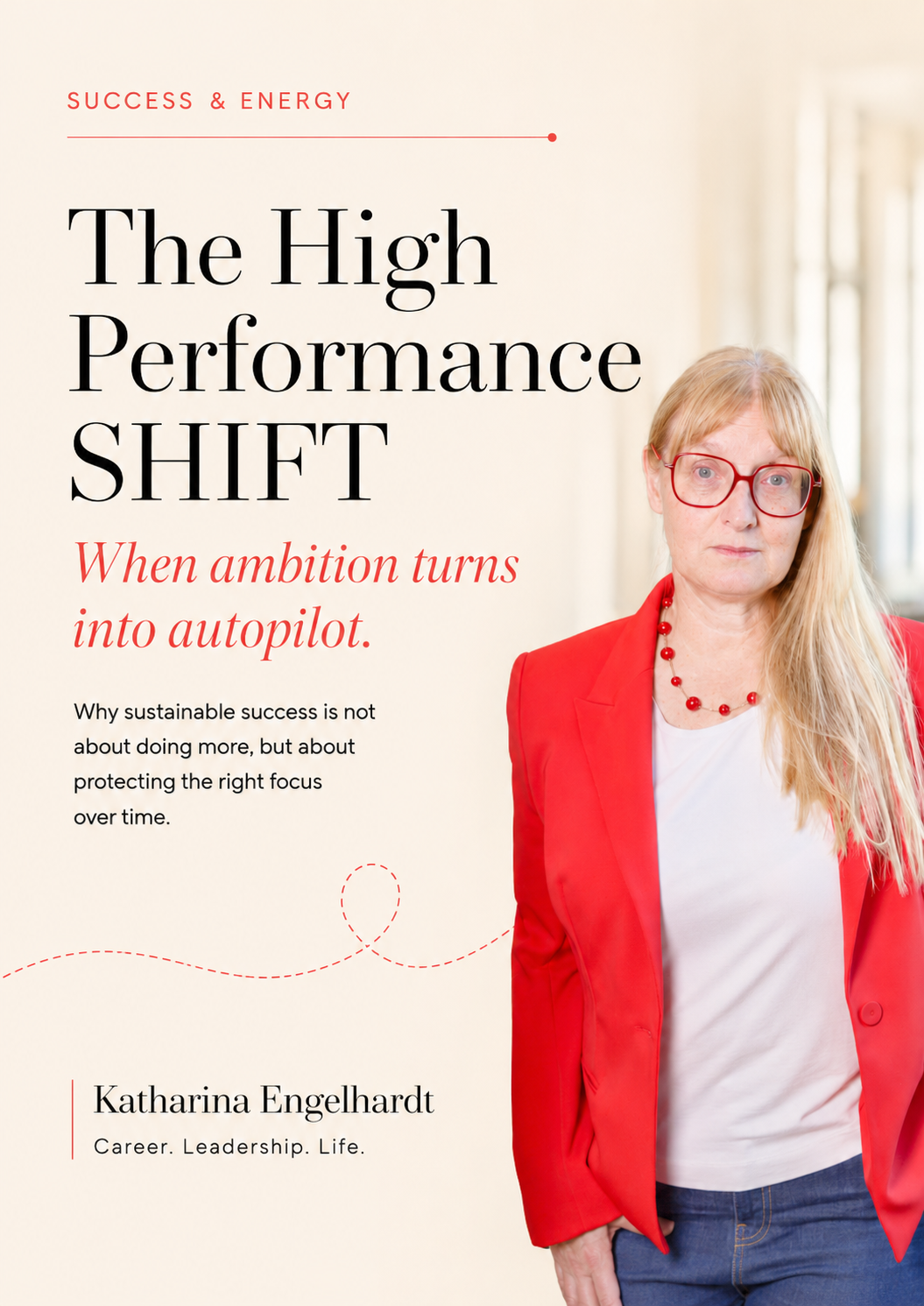
The High Performance SHIFT: When Ambition Turns Into Autopilot
Why sustainable success is not about doing more, but about protecting the right focus over time.
“I am doing so much. So why does it still feel as if I am not moving forward?” I hear this sentence from women who are not underperforming. Quite the opposite.
They are often the ones who deliver, organise, prepare, support, respond, remember, connect, solve, hold the team together, keep the project moving, make the meeting work, answer the message, smooth the tension, carry the complexity and still manage to show up at home with some version of a dinner, a school form, a birthday present, a dentist appointment and a half-charged phone.
They create a lot. They are not waiting for life to happen. They are making things happen. And yet, something feels off. At the end of the week, the calendar is full, the inbox is slightly less accusing, the team is grateful, the family logistics somehow worked, the work moved forward, and still there is this quiet question underneath it all:
What did I actually move that matters?
Not just what did I complete.
Not just who did I help.
Not just which fire did I put out before anyone else noticed the smoke.
But what did I move that truly matters for my leadership, my visibility, my energy, my business impact and the life I say I want to build? That is often the moment when ambition has turned into autopilot. Not because the ambition is gone. But because it has lost direction.
When high performance becomes high functioning
For a long time, many high-achieving women learn that performance means staying on top of things.
You are reliable.
You deliver.
You think ahead.
You make things work.
You do not drop the ball.
You keep going when others slow down.
You sense what needs to happen before somebody formally asks.
And for a while, this works beautifully.
It builds trust.
It creates reputation.
It makes you someone others can count on.
But over time, the same pattern can become expensive. Because there is a difference between high performance and high functioning. High functioning means you keep the machine running, even when the machine is badly designed, overloaded or pointed in the wrong direction. High performance means you create meaningful, sustainable impact over time.
Brendon Burchard defines high performance as “succeeding beyond standard norms, consistently over the long term.” I like this definition because the important part is not only beyond standard norms. The important part is consistently over the long term. You cannot call something high performance if it only works by driving yourself into the ground and then calling the crash “a season.”
For many women in corporate roles, this distinction matters deeply. Because they are very good at functioning. They can keep going through pressure, uncertainty, restructuring, leadership changes, difficult stakeholders, invisible expectations and private responsibilities that never appear in a performance review. But the question is no longer only: Can I handle this? The better question is: Is this way of handling everything creating the career and life I want?
The work that keeps everything moving except your own leadership
One of the quiet traps in women’s careers is that a lot of useful work is not the same as strategic work.
Some work keeps the system running.
Some work makes the team feel safe.
Some work prevents problems from becoming visible.
Some work creates harmony, clarity, quality, coordination and emotional stability.
All of those matters. The problem is that not all work carries the same career value.
Research by Linda Babcock, Maria Recalde, Lise Vesterlund and Laurie Weingart on tasks with low promotability shows that women are more likely than men to volunteer for, be asked to do and accept work that helps the organisation but does not necessarily advance the individual’s career. These tasks are useful, often necessary and sometimes deeply appreciated, but they are less likely to lead to visibility, advancement or recognition.
This is such an important point for high-performing women. Because many women are not doing too little. They are doing too much of the work that keeps everything moving — and too little of the work that moves their own leadership forward.
They take the notes.
They organise the alignment.
They prepare the emotional ground.
They onboard the new person.
They remind the team.
They translate between stakeholders.
They fix the thing that would otherwise become messy.
And because they do it well, the work often disappears.
It becomes normal.
It becomes expected.
It becomes part of their identity.
She is so reliable.
She is so helpful.
She always makes things work.
Lovely.
But “helpful” is not the same as strategically visible.
And “needed” is not the same as recognised.
This is where a woman can spend years creating enormous value and still feel under-positioned, because the value she creates is absorbed by the system instead of being translated into authority, sponsorship or career movement.
Busy can look like meaning
The difficulty is that busyness can feel strangely reassuring. When you are busy, you have evidence.
You answered.
You helped.
You joined.
You delivered.
You solved.
You were needed.
You did not disappoint.
Busy gives the day a shape. Clarity is harder. Clarity may ask whether the work you are doing is the work that matters. It may ask whether the meetings you attend are where your leadership should be built. It may ask whether the people who benefit most from your effort are also the people who recognise your value. It may ask whether your calendar reflects your priorities, or simply everybody else’s access to you.
And sometimes, when clarity is missing, busyness feels safer than choice. Not because you are weak. Because busyness is rewarded. In many corporate cultures, a full calendar still looks important. Late emails still look committed. Being everywhere still looks responsible. Having no time still sounds like status, as if exhaustion were a luxury handbag with worse posture.
Research by Silvia Bellezza, Neeru Paharia and Anat Keinan shows that busyness and lack of leisure time have become status symbols in many work cultures, because an overworked lifestyle can signal that someone is important, in demand and valuable.
That explains why it can be so hard to step out of the pattern. Busyness is not only a time problem. It is a status signal. A protection strategy. A belonging strategy. Sometimes even a way to avoid the questions that would ask us to change something more fundamental. Busy is not always productive. Sometimes it is the most socially accepted way to avoid the questions that would actually change our leadership.
The attention cost of doing everything
There is another problem with constant doing: It fragments the mind. A woman can work the whole day and still not have one truly focused hour on the work that would change her career, her team or her energy.
She moves from meeting to message, from decision to request, from project to personal logistics, from stakeholder concern to school WhatsApp group, from strategy document to “quick question,” and every transition seems small until the whole day feels like a thousand tiny cuts into her attention.
Sophie Leroy’s research on attention residue shows that when people switch from one task to another, part of their attention can remain stuck on the previous task, making it harder to fully transition and perform well on the next one. Her work helps explain why constant switching can make people feel busy and tired, but not necessarily deeply effective.
This matters because focus is not simply a productivity issue. Focus is a leadership resource. If your attention is constantly fragmented, your leadership becomes reactive. You may still be doing a lot, but you are no longer choosing enough. You may still be answering, supporting and solving, but you may not be protecting the work that creates long-term impact. And when the week is over, you may have been useful everywhere and strategically present nowhere. That sentence hurts a little. But it is often where the shift begins.
When discipline points in the wrong direction
Many high-performing women do not lack discipline. They have discipline in abundance.
They meet deadlines. They prepare properly. They follow through.
They hold standards. They take responsibility. They show up even when they are tired.
The problem is not missing discipline. The problem is misdirected discipline.
Discipline can be spent on answering everything quickly. Or on protecting deep work.
Discipline can be spent on being available everywhere. Or on being visible where decisions are shaped.
Discipline can be spent on keeping everyone comfortable. Or on having the conversation that actually matters.
Discipline can be spent on doing more. Or on choosing better.
That is a very different form of leadership.
A high performer may ask: How can I get more done?
A high-performance leader asks: What must I protect so that the right work, the right people and the right version of my life can grow?
That is not a small shift. It is the difference between being driven by demand and being led by direction. And it is often uncomfortable, because it requires saying no not only to things we dislike, but also to things we are very good at. This is one of the hardest parts. Sometimes the work you need to reduce is work that gives you a sense of being needed. Sometimes the role you need to renegotiate is the one where everyone appreciates you. Sometimes the habit that drains your energy is also the habit that built your reputation.
That is why the shift is not only practical. It is personal.
When performance becomes identity
For many women, performance is not only a behaviour. It has become a source of safety.
If I perform, I am valued.
If I deliver, I belong.
If I help, I am needed.
If I keep going, I am strong.
If I do not disappoint, I am safe.
No one usually says this so directly, of course. Most of us are far too sophisticated for that. We say things like “I just have high standards” or “I like things done properly” or “It is easier if I do it myself” or “This is just a busy phase,” which is one of the most dangerous sentences in corporate life because it can apparently last twelve years. But underneath, there may be a deeper pattern. When performance becomes the currency of self-worth, rest does not feel like rest. It feels like risk. A slower week can feel like falling behind. An empty hour can feel suspicious. A boundary can feel selfish. A no can feel like disappointing someone. A day without visible output can feel like you are losing value. This is why sustainable high performance cannot be built only with better time management.
It has to include self-leadership. The ability to notice the pattern before it owns the day. The ability to ask whether the next yes is truly aligned. The ability to tolerate the discomfort of not being constantly needed. The ability to protect recovery without making it a moral negotiation. The ability to remember that your value is not identical with your output.
High performance is not more pressure in elegant shoes. It is a more conscious relationship with your energy, your focus, your choices and your ambition.
The private-life cost of unfocused success
This is also where business life and private life cannot be separated as neatly as many career conversations pretend. A woman can be successful at work and still feel absent from her own life. She may sit at dinner with her family and realise that her body is there, but her mind is still in the meeting where one comment annoyed her. She may listen to her child speak and notice that she has not really heard the last three sentences. She may finally have a quiet evening and automatically open her phone, not because something is urgent, but because her nervous system no longer knows how to arrive. This is not because she does not care. It is because attention follows habit.
If the whole day has trained her to react, switch, solve and scan, she
cannot always become present simply because the laptop is closed. That is why sustainable success is not only about career strategy. It is also about how you want to experience your life while building that career. The question is not: How can I squeeze more into the week. The question is: What should this week protect?
Your leadership needs protection.
Your energy needs protection.
Your relationships need protection.
Your thinking needs protection.
Your future self needs protection.
And yes, sometimes your calendar will still be full. This is real life, not a wellness retreat with excellent branding. But even in a full week, the question remains:
Does this week reflect what I say matters?
The High-Performance SHIFT
This is the shift I care about. Not from ambitious to relaxed. Not from high standards to low standards. Not from career to private life. The shift is from autopilot to conscious leadership. From constant reaction to chosen focus.
From being useful everywhere to being impactful where it matters.
From proving through output to leading through direction.
From busyness as identity to focus as responsibility.
From success that looks full to success that actually holds.
That is what high performance means to me in the context of women’s careers. It is not the ability to do more forever. It is the ability to stay connected to what matters over time.
In my SHIFT work, this is where we begin to look at clarity, energy, courage, productivity, influence and the inner architecture that allows a woman to lead without losing herself.
Because sustainable success is not built by adding more pressure.
It is built by learning what deserves your best energy and what only looks urgent because you have been trained to respond.
A practical reflection: the Focus-Over-Time Audit
If you want to make this practical, do not start with a complete life redesign. Start with one week. Take ten minutes at the end of the week and ask yourself five questions.
First: Impact.
What did I do this week that created real business, leadership or career value?
Second: Recognition.
What did I do that others appreciated, but that may not move my leadership forward?
Third: Energy.
What restored me, and what quietly drained me?
Fourth: Life fit.
Did my calendar reflect the life and leadership I say I want?
Fifth: Protection.
What do I need to protect next week because it matters over time?
Then write one sentence:
This week, I will protect _____________________________ because it creates long-term impact, and I will reduce, renegotiate or decline ______ _______________________________ because it keeps me busy but not aligned.
This is not a productivity trick. It is a leadership practice. Because the question is not whether you can do more. The question is whether your doing is still serving the future you want.
Ready for your own SHIFT?
If this article made you realise that you are doing a lot, but not always focusing on the work that creates recognition, visibility and long-term career value, I would love to invite you to my free SHIFT Session:
The SHIFT Sessions: Strengths Are Career Capital
In this 30-minute impulse session, we will look at how to stop treating your strengths as “normal” and start seeing them as the foundation of your visibility, confidence and career value.
Because often, the first step is not doing more.
It is understanding what already creates value — and learning to protect, name and use it more strategically.
Join the free SHIFT Session here: www.thefemaleshiftatelier.de/StrengthsAreCareerCapital
Stay courageous, Katharina
Sources
Babcock, L., Recalde, M. P., Vesterlund, L., & Weingart, L. (2017). Gender Differences in Accepting and Receiving Requests for Tasks with Low Promotability. American Economic Review, 107(3), 714–747.
Bellezza, S., Paharia, N., & Keinan, A. (2017). Conspicuous Consumption of Time: When Busyness and Lack of Leisure Time Become a Status Symbol. Journal of Consumer Research, 44(1), 118–138.
Burchard, B. (2017). High Performance Habits. The High Performance Institute defines high performance as succeeding beyond standard norms consistently over the long term.
Leroy, S. (2009). Why is it so hard to do my work? The challenge of attention residue when switching between work tasks. Organizational Behavior and Human Decision Processes, 109(2), 168–181.
Pin this graphic if you liked the post.