I once had a woman on my team who could discuss a decision for a very long time. She was thoughtful, interested in other perspectives and genuinely wanted to bring people with her. Those were qualities I valued. The problem was that, at some point, a decision still had to be made.
I often had a fairly clear view of what I would do. Giving her my answer would have been quicker and probably more comfortable for both of us. Instead, there were moments when I simply said: “Decide.” Not next week, not after another round of conversations. Now. She did not particularly enjoy that. And if I am honest, I did not always enjoy watching the process either. When you have spent years becoming good at solving problems, it takes discipline not to solve one that is sitting right in front of you.
Over time, though, something changed. She realised that the decisions she made more quickly were not worse than the ones she had spent days thinking through. She began to trust her own judgement more. And I began to understand something about my own job as a leader: Being able to solve a problem does not necessarily mean that solving it is your most useful contribution. That sounds obvious once you say it out loud. In practice, it can be one of the harder transitions in leadership.
When performance stops scaling
Many high-performing women build their careers by becoming exceptionally reliable. They know the detail, notice what is missing, step in when something is going off track and take responsibility when others hesitate. They become the person people trust with difficult things. That reputation is valuable. It may well be one of the reasons they are promoted.
But when responsibility grows, the job begins to change. You are no longer responsible only for producing strong work yourself. You are expected to set direction, make decisions with incomplete information, influence across functions, develop other people and create enough clarity for good work to happen without your constant intervention.
The difficulty is that the habits that made you successful are still available. A problem appears and you know how to solve it. A piece of work is not quite right and you know how to improve it. Someone is stuck and you can see the answer. Stepping in can be entirely rational. The work gets finished, the quality is protected and everybody moves on. But there is a difference between solving today’s problem and building the capacity to solve tomorrow’s.
This is where an old measure of performance can quietly become a leadership bottleneck. If the value you create continues to depend mainly on what you personally know, fix, review or rescue, your responsibility may have grown while your operating model has not. What made you a strong performer will not automatically make you an effective leader. The transition is not from caring about results to caring less. It is from producing the result yourself to creating the conditions in which good results can increasingly happen through other people. I explore the wider version of this pattern in Why Your Capability Cannot Be the Operating Model.
Leadership is not withdrawal
This is why I find “delegate more” rather thin advice. The difficult part is rarely only handing over a task. It comes afterwards, when another person approaches it differently, needs longer than you would, produces a first version you would have improved immediately or makes a decision that is reasonable but not the one you would have made.
That is when leadership becomes uncomfortable. You may genuinely have more experience. The stakes may genuinely matter. There are situations in which intervention is exactly what the role requires. But there are also moments when the urge to intervene has less to do with what the work needs and more to do with how difficult it is to watch someone else develop judgement in real time.
In my example, I was not withdrawing support from the woman on my team. I was changing the support I gave her. My role was not always to supply the answer. Sometimes it was to create enough clarity and pressure for her to discover that she could reach a sound decision herself.
Research on delegation reflects some of this tension. Managers do not simply choose between “control” and “freedom”. Their willingness to grant autonomy is influenced by factors such as the knowledge people hold, the nature of the work and how easily progress can be monitored. Research on empowering leadership also suggests that creating greater ownership can support performance and other positive work behaviours, while context and boundaries still matter.
Usually, that means clarity about the outcome, the boundaries of the decision, where somebody can act independently and when the issue genuinely needs to come back to you. Responsibility does not disappear when execution moves away from the leader. It changes shape.
That distinction matters. Control can easily disguise itself as responsibility: I need to review this because I am accountable. I need to make the final call because the risk is high. I need to correct this because the standard matters. Sometimes that is true. If it is true every time, it is worth looking more closely.
The system learns from what you keep carrying
I would also be cautious about treating this only as a personal development issue. Yes, there is a personal layer. Being needed can feel reassuring. High standards can make it difficult to accept another route. For someone whose career has been built on reliability, stepping back from execution can even feel like reducing her contribution rather than changing it.
But there is also the role. Has it actually become clear what you should stop doing as your responsibility grows? Or has a larger title simply been added to the workload you already had?
And there is the system around you. Does your team genuinely have the authority and capability to make the decisions you want them to own? Are escalation points clear? What happens when somebody gets it wrong? Does the organisation praise ownership but still expect the most reliable person to quietly catch whatever falls between the cracks?
Highly capable people can keep unclear systems functioning for a surprisingly long time. They fill gaps, answer questions that should have been resolved elsewhere and absorb work so that the organisation does not immediately feel the consequences of unclear roles or decision rights.
Because they do it well, the system learns. The difficult questions come back to them. The unfinished work comes back to them. Their calendar fills with reviews, approvals and decisions that other people might have learned to own if the pattern had developed differently. A related pattern is explored in When “I Can Handle It” Becomes a Career Trap, where reliability starts turning into over-carrying.
This is one reason a calendar can be revealing. Not as another productivity tool, but as evidence of the role you are actually playing. A full calendar does not prove that you are a bottleneck. Leadership roles can be intense, crises happen and some periods require deep involvement. But recurring patterns are useful information. If your strategic thinking is repeatedly pushed into evenings because the working day is filled with decisions and problems that should sit elsewhere, the issue may not be that you need to organise yourself better. And when overwork itself starts to look like proof of commitment, Stress Pride Makes You Blind looks at the sustainable-success side of the same pattern.
Your leadership model and perhaps the system around you may still depend too heavily on your personal performance.
A different measure of contribution
The transition from performer to leader does not require becoming less ambitious, less responsible or less committed to quality. It asks you to direct those qualities differently. There will still be problems only you should solve. There will still be decisions that belong with you. The question is whether you can distinguish those from the work you continue to carry simply because you can do it well.
That distinction changes how you measure your own contribution. The evidence of a good week is no longer only what you personally completed. It may also be a decision someone made without waiting for you, a colleague who is becoming more confident in her judgement, a responsibility that now sits where it belongs or a piece of strategic work that finally had space because you did not spend the afternoon fixing somebody else’s.
This is also a theme I work on repeatedly with experienced women in my coaching. Not because they need less drive, but because a bigger role often requires them to use that drive differently. Susanne described it beautifully after our work together:
“I use my drive more consciously now — and give my team more room to take responsibility.”
Susanne, coaching client
I like the sentence because nothing valuable had to disappear. Her drive was still there. The question was where it could create the most value in the role she had now. That, for me, is one of the quieter transitions into leadership: becoming more deliberate about where your capability belongs.
Your value as a leader is not measured by how much you personally solve. It is also visible in what other people become able to solve because you lead them.
This is the kind of transition we work on in SHIFT: sustainable performance that fits the responsibility you carry now, rather than the role that first taught you how to succeed.
Sources:
Van Triest, S. & Williams, C. (2024). Following the chain of command? How managers balance benefits and risks in granting autonomy to employees. European Management Journal, 42(1), 89–97.
Lee, A., Willis, S. & Tian, A. W. (2018). Empowering leadership: A meta-analytic examination of incremental contribution, mediation, and moderation. Journal of Organizational Behavior, 39(3), 306–325.
Pin this graphic if you liked the post.
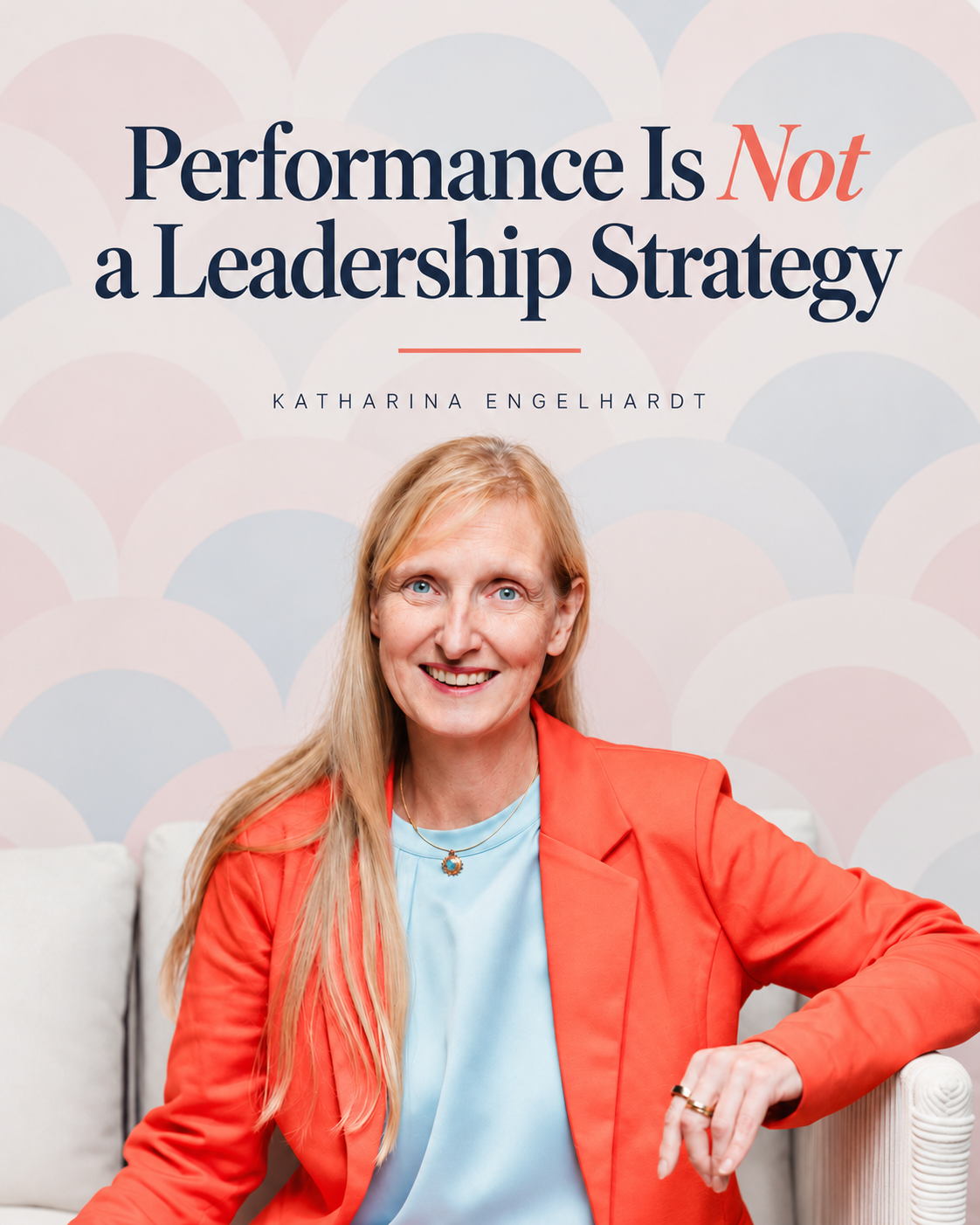
Kathrina Engelhardt shares strategic questions females in the workplace
should ask more often