The Strengths SHIFT: Why Your Strengths Are Career Capital, Not Self-Discovery Fluff
What team strengths coaching reminded me about flow, visibility and the way women learn to speak about their value in a world trained to notice deficits first.
There is a moment in strengths coaching that I never get tired of. It often starts quietly.
A woman looks at her CliftonStrengths profile, scans the list, and before she has even taken in what is actually there, her eyes move to what seems to be missing.
Not enough influencing.
Not enough communication.
Not enough strategic presence.
Not enough of whatever she believes leadership is supposed to look like.
One client said it beautifully after a Strength Sprint:
“I looked at my profile and immediately focused on what seemed to be missing. I saw the influencing and communication themes lower in my profile and thought: there it is,
black on white — this is what I cannot do.”
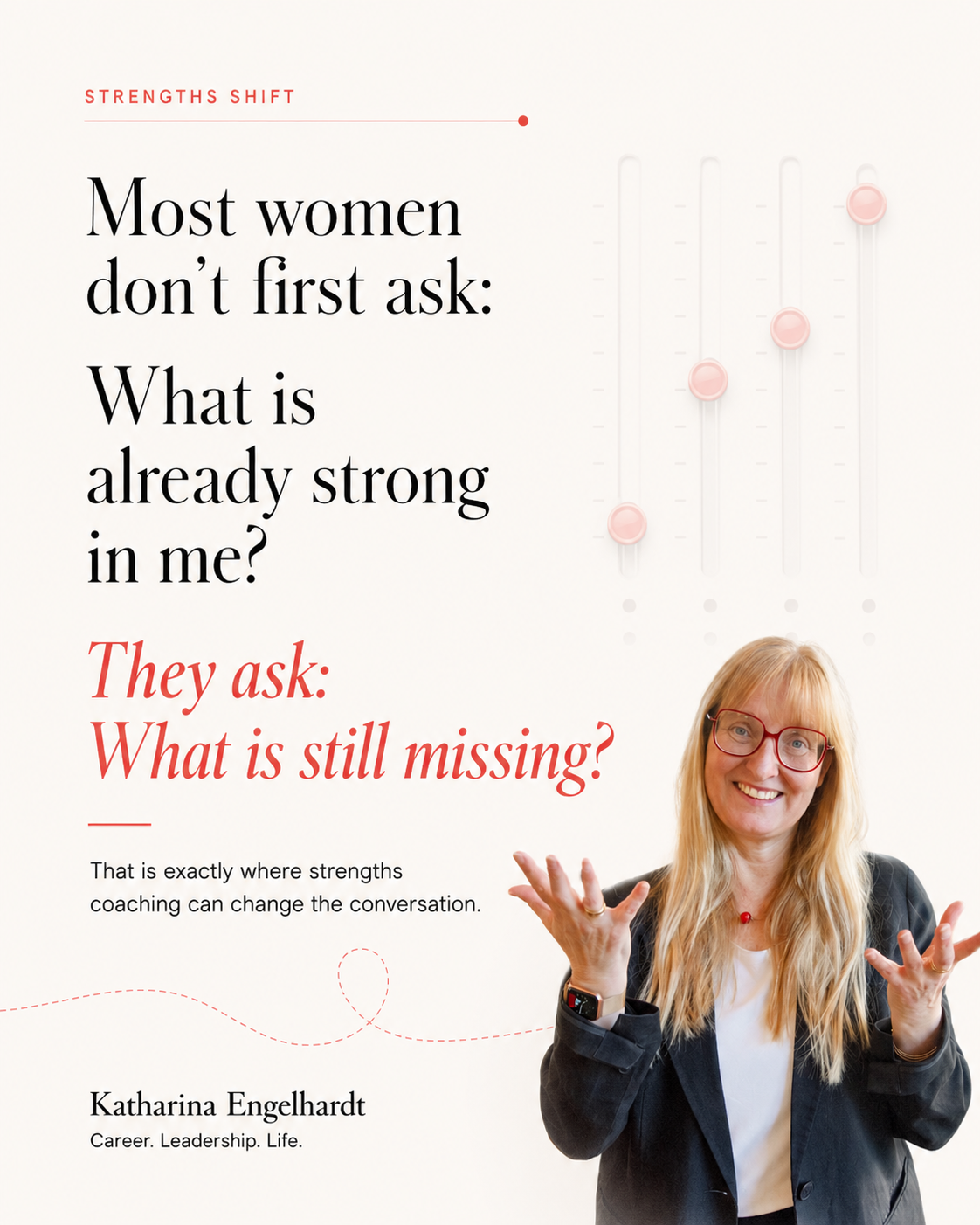
This sentence stayed with me because it is so honest. And because it is so common. Many women do not first ask: What is already strong in me? They ask: What is still missing?
Of course, that did not come from nowhere. Most corporate development conversations are built around gaps. What do you need to improve? Where is your development area? What feedback did you receive? What is still not strong enough? What do you need to fix before you are ready?
And to be clear: development matters. I am not suggesting we all sit in a circle, admire our Top 10 and pretend that every difficult pattern is simply “a beautiful talent expressing itself.” That would be charming for about twelve minutes and then completely useless.
But when we only develop from the deficit side, something important gets lost.
We may become more polished.
More careful.
More adapted.
More acceptable.
But not necessarily more powerful.
And this is why strengths work matters.
Not because it gives us nicer words for ourselves.
Not because it wraps personality in a more flattering ribbon.
And definitely not because we need one more assessment to put in a drawer, next to the feedback report from 2018 and the leadership competency model nobody can remember without opening the intranet. Strengths become powerful when they help us understand how we naturally create value.
Not in theory.
In real situations.
In conversations.
In meetings.
In conflict.
In moments of pressure.
In the way we build trust, solve complexity, move work forward, hold teams together, see patterns, ask questions, organise chaos or bring energy into a room that has emotionally turned into cold porridge.
That is the Strengths SHIFT.
From: What am I missing?
To: What is already working in me and how can I use it more consciously?
We are trained to notice deficits first
One of the reasons strengths work can feel surprisingly emotional is that it interrupts a very familiar pattern.
Most of us have learned to scan ourselves for improvement areas. Especially many women in corporate environments have become very skilled at reading expectations, anticipating criticism and closing perceived gaps before anyone else points them out. This can look professional. It can even be rewarded. You prepare more. You overdeliver. You become reliable. You make sure nobody has to worry. You smooth things before they become visible. You sense the atmosphere. You notice the missing pieces. You compensate.
And then, at some point, your strength turns into your job description. Not officially, of course. Officially, your job description still looks neat and strategic. But underneath, you become the person who carries complexity, emotional weather, alignment, quality, preparation, delivery, reminders, invisible coordination and the psychological safety of three teams and one very tense steering committee. The problem is not the strength itself. The problem is that nobody taught you how to use it without becoming used by it.
Positive psychology helped shift attention from only asking what is wrong with people to also asking what is right with them. In strengths-based coaching, this does not mean ignoring challenges. It means starting from usable energy, existing capability and the conditions under which people can perform with more authenticity and effectiveness. Research on signature strengths has linked strengths use with goal progress, psychological need satisfaction and well-being, while workplace studies suggest that strengths interventions can improve strengths use, performance, engagement and organisational citizenship behaviour when people actually apply their strengths over time. That last part matters. The power is not in knowing the label. The power is in using the strength differently.
Strengths are not labels. They are patterns of impact.
I have written before about what a strengths profile can reveal beyond a job title. In that foundational article, I explored how strengths can help women understand their natural patterns, their career clarity and their visibility more deeply. You can read it here: What your strengths can reveal beyond your job title. Strengths become truly powerful when we stop treating them as labels and start observing how they show up in real stories, real conversations and real team dynamics. Because a strength profile is not a personality horoscope with better branding. It is more like a map. But even the best map does not tell you how the terrain feels under your feet. It does not tell you where the path gets muddy, where you tend to walk too fast, where you always carry everyone else’s backpack, or where you suddenly feel light because the landscape fits your natural rhythm. That is what coaching can reveal.
A client may come into a session thinking she lacks influence because her influencing themes are not at the top of her profile. But when we look at her career stories, another picture appears. She influences through trust. Through reliability. Through seeing patterns. Through bringing people together. Through responsibility. Through positive energy. Through making complex things workable. Suddenly the question changes.
Not: Why am I not better at influencing like someone else?
But: What is my natural way of influencing and how can I make it more visible and apply it consciously? One client described the shift like this:
“I realised that influencing does not have to look loud, charismatic or performative. I do influence others. Just in a different way.”
That is career capital. Because many women are not lacking impact. They are lacking language for their impact. And without language, value often stays invisible.
The flow feeling: when work starts to fit
There is another layer that I find essential in strengths work: flow. Flow is not the same as ease. It is not laziness, comfort or a magical workday where your inbox behaves like a well-trained golden retriever. Flow can happen in intense work. Sometimes even in very demanding work. But there is a different quality to it.
You are focused. You are engaged. You feel challenged, but not constantly overwhelmed. You are using something that feels natural to you, even if the situation itself is complex. Your attention has direction. The work starts to move with you instead of constantly pulling against you.
Mihaly Csikszentmihalyi’s work on flow describes this state as deep involvement, often supported by clear goals, immediate feedback and a strong match between challenge and skill. That is why flow matters so much in career and leadership work: it gives us data about where our strengths may be active.
In strengths coaching, I often listen for these moments.
When does the client speak faster?
Where does her face change?
Which story suddenly has energy?
Where does she say, “I could do this for hours”?
Where does she describe hard work that did not drain her in the same way?
That is not random. Flow is information. It tells us where a strength may be moving through the work with less friction. A strength in flow feels like a well-cut garment. It does not pull at the shoulder every time you move. It gives you room. It holds shape. You can breathe in it. You can raise your arms without wondering whether the whole construction will give up on you. And this matters deeply for women who have spent years working in roles, systems or expectations that technically fit on paper but quietly cost too much energy.
Sometimes the question is not: Am I capable of this?
Often, the more important question is: Can I keep doing this without cutting away too much of myself?
The Strengths Mixing Board: When a Strength Becomes Too Loud
This is where strengths work becomes more than appreciation. Because your strongest patterns are not automatically your best behaviour in every situation. A strength can be brilliant in one context and too loud in another.
This is why I like the image of a strengths mixing board. Imagine each strength as one channel on a mixing board. Some sliders are naturally turned up in your profile. Some sit more quietly in the background. Some strengths carry the melody. Others create rhythm, depth or structure. And depending on the room you are in, the people you are with and the impact you want to create, the question is not only which strengths you have.
The more important question is: what is the right mix for this moment? Because even beautiful music becomes difficult to listen to when one channel dominates everything else. The same is true for strengths. A strength does not become a problem because it is strong. It becomes difficult when its volume is unconscious.
Responsibility, for example, can create trust, reliability and deep ownership. People know they can count on you. You keep promises. You do what you said you would do. In a team, that can be gold. But when Responsibility becomes too loud, it may turn into over-responsibility. You start carrying things that were never yours. You feel personally accountable for everyone’s clarity, everyone’s emotions and every possible outcome. At some point, your strength no longer supports your leadership. It quietly becomes the backpack you wear even in the shower.
Empathy can help you sense what people need, read the room and build trust. But when Empathy becomes too loud, you may absorb emotional weather that does not belong to you. You may feel with others so deeply that you start taking over for them. One client captured this insight with painful clarity:
“I understood the difference between feeling with others and taking over for them.”
That sentence is a whole leadership development programme in one line.
Achiever can create momentum, discipline and drive. It helps you move things forward. But when Achiever becomes too loud, every day becomes a proving ground. You may find it difficult to stop, celebrate or allow something to be good enough for now. This is where one sentence can become surprisingly liberating: “I can improve it later.” For a perfection-trained, high-performing woman, that sentence can feel almost rebellious. Like leaving the house with slightly imperfect eyeliner and discovering that society does not collapse.
Arranger can make complexity workable. It sees moving parts, dependencies, people, timing and possibilities. But when Arranger becomes too loud, you may become the invisible operating system of the team. Everything works because you are quietly connecting all the cables. And because everything works, nobody sees the cables.
Strategic can see patterns and possible paths quickly. This can be incredibly valuable in leadership. But when Strategic becomes too loud, you may become impatient with people who need more steps, more context or more emotional landing space before they can move with you.
Positivity can bring energy, hope and momentum. But when it becomes too loud, it may skip over frustration, conflict or grief before they have been properly understood.
None of these strengths are the problem. The problem is unconscious volume. Strengths coaching helps you ask:
Where is this strength helping me create impact?
Where is it creating tension?
Where does it bring me into flow?
Where does it quietly exhaust me?
Where do I need to turn it up?
And where do I need to turn it down so the whole room can hear the music again?
Why this matters for visibility
Visibility is often misunderstood. Many women hear visibility and imagine they have to become louder, shinier, more self-promotional or slightly more LinkedIn-flavoured than feels emotionally healthy.
But visibility is not about becoming someone else. Visibility begins with being able to explain your contribution. Not only what you did.
But how you created value. This is where strengths work becomes career work.
If you say, “I supported the team,” that may sound nice but vague.
If you say, “I helped the team move through a complex decision by creating structure, naming the tensions, building trust between stakeholders and keeping momentum when the process got stuck,” that is different. Now your contribution has shape. Now your strengths are visible. Now the work is no longer floating around as invisible glue.
This is especially important for women because so much of women’s work is often relational, connective, anticipatory or stabilising. It holds systems together, but it is not always named as leadership. Strengths language can help make that work more visible without turning it into a performance. One client put it like this:
“This feels less like selling myself and more like finally having words for what I actually contribute.”
That is the point. When you understand your strengths, you do not need to invent a louder version of yourself. You can become more precise about the value already there.
Strengths are personal. But they are also organisational
Strengths-based development is not a niche coaching trend. CliftonStrengths is widely used in organisations; Gallup says more than 34 million people have discovered their CliftonStrengths and that more than 90% of Fortune 500 companies have used CliftonStrengths in their workplace culture.
That matters because strengths become even more powerful when they move beyond individual self-awareness and become shared language in teams.
A recent Gallup case discussion about L’Oréal Asia describes how CliftonStrengths was used as part of broader culture work, including team conversations, feedback, trust and simple shared principles. I find that interesting because it shows the real potential of strengths work: not just “I know myself better,” but “we understand each other’s operating systems better.” In teams, this can change the quality of conversation.
Instead of saying, “She is always pushing,” we might ask whether Achiever, Focus or Responsibility is turned up very high.
Instead of saying, “He is slowing us down,” we might recognise Deliberative, Analytical or Context trying to protect the quality of the decision.
Instead of saying, “She is too emotional,” we might see Empathy, Harmony or Individualization picking up signals others are missing.
This does not remove accountability. Nobody gets to say, “Sorry I interrupted everyone again, my Command made me do it.” Strengths are not a permission slip for poor behaviour. But they can make patterns discussable without turning every feedback conversation into a personality trial. And in complex teams, that is already progress.
A small Strengths SHIFT scan
If you want to make this practical, do not start by staring at your Top 10 as if they were a secret code you need to crack before dinner. Start with a story.
Pick one recent professional situation that went well. Not necessarily a huge achievement. It could be a meeting, a difficult conversation, a decision, a moment where someone relied on you, or a piece of work that moved something forward.
Then ask yourself:
What was the situation?
What did I naturally notice that others may have missed?
What did I do that moved the situation forward?
What did people rely on me for?
Where did I feel energy or flow?
Which strength pattern might have been active?
Where did this strength help?
And where could the same strength become too loud?
This is a small exercise, but it changes the direction of attention.
You are no longer asking, “What is wrong with me?” You are asking, “What works through me when I create impact?” That question has a very different energy. It does not make you complacent. It makes you clearer.
Make the most beautiful dish with the spices you already have
One image from a client stayed with me:
“Make the most beautiful dish with the spices you already have.”
I love this sentence because it captures the whole idea. Strengths work does not mean you never learn new things. Of course you do. You can build skills. You can practise communication. You can become more strategic. You can learn to influence more effectively. You can develop presence, courage and authority. But you do not need to begin by despising your own ingredients.
You do not need to become cinnamon if you are rosemary.
You may just need to understand what kind of dish you are here to create, which spices you use too generously, which ones you forget you have, and which combinations make the whole thing taste like you. This is where the Strengths SHIFT becomes more than self-awareness. It becomes a different way of leading yourself. With more appreciation. More precision. More flow. More language.
And, sometimes, with the relief of realising that you do not need to become someone else to create impact. You may simply need to understand more clearly how you already do.
Ready for your own Strengths SHIFT?
If this resonates with you, I would love to explore it with you.
In my coaching, we do not use your strengths profile as a label collection. We use it as a starting point for career clarity, visibility, self-leadership and impact. We look at how your strengths show up in real stories, where they bring you into flow, where they become too loud, and how you can speak about your value with more confidence and ease.
If you want to understand not only what your strengths are, but how they can help you shape your next career chapter, I invite you to book a discovery call. Because your strengths are not decorative. They are career capital. And they are already in you.
Sources
1. Harvard Business Review, How Biases About Motherhood Impact All Women at Work, 2024.
2. Destatis, Gender Care Gap 2022: women perform 44.3% more unpaid work than men, 2024.
3. Destatis, Parents working part time, 2023 data.
4. Reuters / ZEW and Tilburg University study, German mothers earn €30,000 less than women without children after first birth, 2025.
5. International Labour Organization, Unpaid care work prevents 708 million women from participating in the labour market, 2024.
6. Deloitte, 2025 Gen Z and Millennial Survey, 2025.
7. Destatis, Births: Germany’s total fertility rate fell to 1.35 children per woman in 2024, 2025.
8. OECD, Society at a Glance 2024, fertility and work-family compatibility.
Pin this graphic if you liked the post.