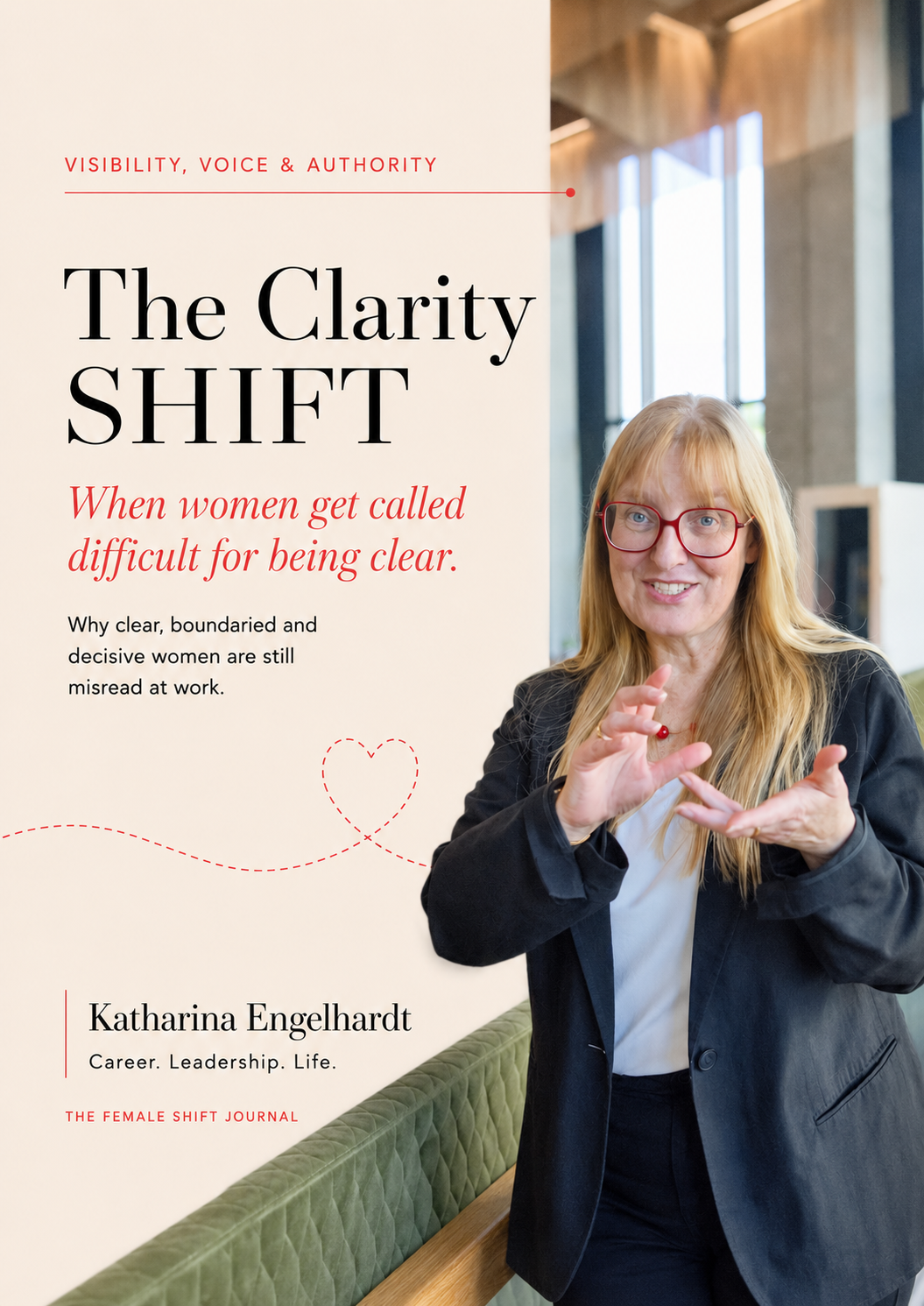
The Clarity SHIFT: When Women Get Called Difficult for Being Clear
Why clear, boundaried and decisive women are still misread at work and how to set a stronger line without becoming softer, harder or someone else.
This article belongs to my series “The New Cut for Women´s Careers” a series about careers in a changing world of work: visibility, strengths, influence, energy and sustainable success. Not as another layer of self-optimisation, but as a new form of professional future-readiness.
The meeting where clarity became a character review
The meeting had been circling the same point for twenty minutes. Everyone could feel it, but nobody quite wanted to name it. The project was behind, the decision had been postponed twice, and the room had settled into that familiar corporate weather pattern: Polite fog with a high chance of another follow-up meeting.
Then she said what needed to be said. She named the trade-off. She explained the risk. She made a recommendation. She was calm. She was prepared. She did not raise her voice. She did not attack anyone. She simply drew a line where the conversation had become too soft to be useful.
Afterwards, the feedback came in one of those sentences that looks harmless until you try to build a development plan from it: "You were a bit difficult in that meeting." Not: Your analysis was wrong. Not: Your recommendation was unclear. Not: You missed an important stakeholder perspective. The feedback was not about the content. It was about how her clarity had been read.
This is where many women in corporate life feel the squeeze. They are expected to be decisive, but not too sharp. Clear, but not too direct. Boundaried, but not uncollaborative. Strategic, but still warm. Visible, but not too visible. Ambitious, but not demanding. Leadership-ready, but never inconvenient. And if they get the balance wrong, the label arrives quickly. Difficult. Too much. Intense. Emotional. Not collaborative enough. Maybe a little harsh.
This is not only a communication problem. It is a leadership double bind.
When clarity becomes a personality issue
One reason this pattern is so costly is that it turns behaviour into identity. A man may be described as decisive. A woman may be described as difficult. A man may be said to have strong opinions. A woman may be told she needs to work on her tone. A man may be seen as direct. A woman may be asked to be more collaborative next time, even when her actual point moved the work forward.
Of course, women can communicate poorly. So can men. This article is not a free pass for bad behaviour wrapped in a coral-red bow. There are moments when all of us need to listen better, slow down, repair impact, or choose a more skilful way into a conversation.
But there is a difference between useful feedback and feedback that makes clarity sound like a character flaw.
Useful feedback says: "When you made the recommendation, you did not name the trade-off clearly enough." Useful feedback says: "The stakeholder impact was missing." Useful feedback says: "Your point was strong, but it came too late in the discussion." Foggy feedback says: "You were difficult."
And foggy feedback is expensive because it sends women into the wrong kind of self-improvement. They may soften every sentence, over-explain every recommendation, add three disclaimers before their actual point, or wait for someone else to say the thing first. Suddenly, the woman who was trying to create clarity becomes busy managing other people's comfort with her clarity.
That is not leadership development. That is energy leakage in elegant shoes.
What the research says: The double bind is real
The research around this topic is not new, but it remains painfully relevant. Alice Eagly and Steven Karau's Role Congruity Theory helps explain why women can be judged against two sets of expectations at the same time: The behaviours often associated with leadership - assertiveness, decisiveness, agency and strategic direction - can clash with stereotypes about how women are expected to behave.
Catalyst describes this as the double-bind dilemma for women leaders: Women can be measured against masculine-coded standards of leadership and then penalized when they show the very behaviours those standards reward. Too warm, and she may not be seen as leader-like enough. Too assertive, and she may be seen as not warm enough. A delightful little career sandwich, just without the delight.
Textio's research on feedback bias shows why the language around performance matters. Words like "emotional," "difficult" or "not collaborative enough" are not neutral decoration; they can shape how women see themselves, how others remember them and which development stories become believable.
McKinsey and LeanIn.Org keep the system lens in place: Women remain highly committed to their careers, but they still receive less career support and fewer opportunities to advance. When support, sponsorship and interpretation are uneven, clarity is not evaluated on a clean stage. It is evaluated inside a system that already reads women differently.
The next generation is questioning the old leadership costume
Deloitte's Gen Z and Millennial Survey adds another layer. Many younger professionals do not simply chase the old version of leadership; they are more cautious about the wellbeing trade-offs that can come with it.
I do not read this as a lack of ambition. I read it as discernment.
Maybe younger professionals are not rejecting leadership. Maybe they are rejecting an old leadership costume: The one where you perform certainty, hide exhaustion, accept constant availability, and learn to speak in a way that protects everybody else from discomfort while you quietly carry the cost.
For women in mid-career, this question is not new. Many have asked it quietly for years: Do I want the next level if it means becoming more exposed, more judged, more available and less myself? Do I want to lead in a system where clarity is needed, but the woman who brings it is called difficult?
This is the point where the conversation must move beyond "women need more confidence." Confidence helps. But confidence alone does not solve a system that misreads clarity. The deeper work is to understand your natural form of clarity, and then build the self-leadership to hold it under pressure.
The Katharina view: A clear line is not a flaw in the pattern
Here is my view: Clarity is not a personality flaw. A clear line is not a mistake in the pattern. It is design.
But design is not the same as volume. A clear line does not have to be loud. It does not have to be cold. It does not have to cut people unnecessarily. Good design knows where the seam needs to hold, where the fabric needs movement, and where a beautiful idea will collapse if nobody reinforces the structure.
That is why I do not teach women to become harder. I also do not teach them to become softer so the room feels more comfortable. I help them understand what kind of clarity is natural to them, what their system tends to reward or misread, and how to set a leadership line that is strong enough to hold without becoming a performance costume.
The shift is not to become less clear. The shift is to become clearer on purpose.
Where strengths coaching becomes the key
This is where strengths coaching becomes much more than a pleasant self-discovery moment. It helps answer a crucial question: What is my natural form of clarity?
Clarity does not look the same in every woman. A woman with strong “Strategic” may create clarity by seeing patterns, options and trade-offs quickly. A woman with strong “Responsibility” may create clarity through commitments, reliability and clean follow-through. A woman with “Empathy” may create clarity by naming what is unspoken in the room. A woman with “Arranger” may create clarity by making complexity workable. A woman with “Analytical” may create clarity through facts, risks and logic. A woman with “Individualization” may create clarity by understanding what different people need in order to contribute well.
That is why I often say strengths are career capital. They are not personality labels. They are clues to how you naturally create value.
In my article The Strengths SHIFT: Why Your Strengths Are Career Capital, Not Self-Discovery Fluff, I wrote that strengths become powerful when we stop treating them as labels and start observing how they show up in real stories, real conversations and real team dynamics. This blog takes that idea into one very specific leadership moment: The moment when a woman needs to be clear, and the room may not like that her line is visible.
Strengths coaching helps a woman stop asking only, "How can I sound clearer?" and ask the deeper question: Which strength is trying to create clarity here?
That question matters because if you do not know the source of your clarity, you may try to imitate someone else's. You may force yourself into a more dominant communication style that does not fit. Or you may soften a strength that is actually trying to protect the work, the team or the decision.
Your clear line becomes stronger when it is rooted in your own strengths, not borrowed from someone else's leadership wardrobe.
Where high performance coaching becomes the second key
If strengths coaching shows where your clarity comes from, high performance coaching helps you hold that clarity when the room becomes uncomfortable.
Many women already know what they want to say. They know the decision is unclear. They know the trade-off is being avoided. They know the meeting has drifted into politeness instead of progress. But when the moment comes, the nervous system gets involved.
The recommendation becomes longer. The sentence gets softer. The boundary gets wrapped in too many apologies. The question is delayed. The woman waits for the perfect opening, which is a highly elegant way of letting the moment pass.
This is not weakness. It is self-protection. For many women, clarity has carried social risk before. So the body learns to reduce exposure.
That is why high performance work matters. Not as pressure to do more, but as the practice of self-leadership under pressure: clarity, courage, energy, influence and emotional steadiness. It helps a woman notice what happens inside her when the room becomes tense. Does she over-explain? Does she disappear into detail? Does she move into harmony? Does she become sharp because she waited too long? Does she become reactive because her energy is already gone?
In The High Performance SHIFT: When Ambition Turns Into Autopilot, I wrote about the difference between doing more and protecting the right focus over time. The same logic applies here. Clarity is not only about saying the right sentence. It is about having enough internal space, courage and energy to say the sentence when it matters.
A woman can have the perfect wording in her notebook and still lose the line if she enters the conversation depleted, over-prepared, under-supported or secretly asking for permission to be taken seriously.
The two keys behind a stronger line
Strengths coaching gives clarity its natural form. High performance coaching gives it stability under pressure.
How this connects to my existing work
This article sits between several ideas I have written about before. In When "Not Ready Yet" Is Not Feedback, I wrote about vague promotion feedback and the five readiness signals women can strengthen: micro-politics, communication, self-leadership, positioning and leadership identity.
In The Visibility SHIFT: You Don't Have to Play a Game. But You Do Need to Read the Room., I explored why visibility is not personal branding theatre, but the ability to understand how influence, stakeholders and systems actually work.
And in The New Cut for Women's Careers, I argued that future-ready careers for women are not built by working harder inside outdated patterns, but by taking new measure: of strengths, visibility, influence, energy, skills, role conditions and choice.
The Clarity SHIFT brings these threads together. It says: When clarity gets you called difficult, do not automatically assume you need to become smaller. First ask: What signal is being misread? Which strength is trying to lead? What self-leadership is needed to hold the line?
The Clarity Line: a tool for clear leadership without performance theatre
Here is the practical tool I would use with a client before an important meeting, feedback conversation, stakeholder discussion or promotion-related moment.
The Clarity Line has two layers and four leadership questions.
The two layers
Layer 1 - Strengths Lens:
What strength is trying to create clarity here?
Layer 2 - High Performance Lens:
What do I need in order to hold that clarity under pressure?
Leadership question and Why it matters
1. What needs to be decided?'
Clarity begins by naming the decision, not by adding more context.
2. What is the trade-off?
Senior leadership is often the ability to make trade-offs visible before they become hidden costs.
3. What is my recommendation?
A recommendation turns observation into leadership.
4. What relationship or system signal do I need to protect?
Clear does not mean careless. You can protect the work and the relationship without dissolving your point.
This tool is simple, but it changes the nature of preparation. You are not preparing to be liked. You are not preparing to win the room. You are preparing to lead the conversation with enough clarity that the work can move forward.
A 10-minute exercise: prepare your next Clarity Line
Choose one real conversation coming up this week. Not a theoretical one. A real one. A meeting where a decision needs to be made, a boundary needs to be set, a recommendation needs to be heard, or a pattern needs to be named.
1. Write the decision in one sentence: "The decision we need to make is..."
2. Write the trade-off in one sentence: "The trade-off is..."
3. Write your recommendation in one sentence: "My recommendation is..."
4. Name the strength behind your clarity: Strategic, Responsibility, Empathy, Analytical, Arranger, Focus, Harmony, Individualization - or another pattern that is active here.
5. Name what you need to stay steady: courage, energy, preparation, a breathing pause, stakeholder pre-alignment, a clearer boundary, or support from a sponsor.
6. Write the line you will use if the room becomes foggy: "Let me bring us back to the decision we need to make."
This is not a magic script. It is a leadership preparation practice. Like tailoring, the line becomes stronger when it is measured before the fabric is under tension.
You are not difficult because your line is visible
Sometimes you will still be misread. That is the honest part. Good preparation does not remove gender bias from a system, just as a beautiful coat does not change the weather. But it changes how you move through it.
When you understand your strengths, you can stop copying someone else's version of clarity. When you build high-performance self-leadership, you can hold your clarity when it becomes uncomfortable. And when you understand the system lens, you can stop making every distorted reaction a private verdict on your personality.
You may still need strategy. You may need sponsorship. You may need allies. You may need to repair impact when your clarity lands differently than intended. But you do not need to treat every label as truth.
Difficult is sometimes the word a system uses when a woman stops making ambiguity comfortable. A clear line is not a flaw in the pattern. It is design.
Ready to hold your Clarity SHIFT?
If this article made you think of a meeting, a conversation or a pattern in your own career, this may be a good moment to look at it more closely.
In SHIFT, my high-performance coaching journey, we work on the self-leadership behind moments like this: clarity, courage, energy, influence and emotional steadiness. We map your clarity line, the strengths behind your contribution, the leadership signal that may be too quiet or misread, and the practices you need to hold that line in real rooms.
This is not about becoming harder, louder or more polished. It is about becoming clearer on purpose - and being able to stay clear when the room gets uncomfortable.
If you want to explore whether SHIFT is the right next step for you, book a SHIFT discovery call with me here..
I am Katharina Engelhardt, founder of The Female Shift Atelier. I help high-achieving women shift from performing to leading - so success holds up over time and feels good.
Stay courageous, Katharina
Sources and further reading
Eagly, A. H., & Karau, S. J. (2002). Role Congruity Theory of Prejudice Toward Female Leaders: https://pubmed.ncbi.nlm.nih.gov/12088246/
Catalyst (2024). The Double-Bind Dilemma for Women in Leadership: https://www.catalyst.org/insights/2024/infographic-the-double-bind-dilemma-for-women-in-leadership
Textio (2024). Language Bias in Performance Feedback: https://textio.com/feedback-bias-2024
McKinsey & Company / LeanIn.Org (2025). Women in the Workplace 2025: https://www.mckinsey.com/capabilities/people-and-organizational-performance/our-insights/women-in-the-workplace
Deloitte (2026). Gen Z and Millennial Survey: https://www.deloitte.com/global/en/issues/work/genz-millennial-survey.html
Further reading: Rudman, L. A. (1998). Self-Promotion as a Risk Factor for Women.
Further reading: Heilman, M. E., & Okimoto, T. G. (2007). Why Are Women Penalized for Success at Male Tasks?
Further reading: LeanIn.Org (2025). Women in the Workplace: Key Findings and Takeaways: https://leanin.org/women-in-the-workplace
Katharina Engelhardt: What Fits Next? A Career Clarity Check-In. https://www.katharinaengelhardt.com/create-clarityscan
Pin this graphic if you liked the post.