Why Strengths Are Future Career Capital - Not Just Self-Discovery
A profile is not the destination
There is a moment I often see in strengths work. A woman reads her profile. She recognises herself. She smiles, maybe a little surprised, maybe a little relieved. Something clicks. Yes, this is me.
And then the report lands somewhere between a notebook, a browser tab and a good intention. Not because the insight was weak. But because insight alone does not automatically become career movement.
That is where many strengths conversations stop too early. They help a woman understand herself a little better, but they do not always help her answer the more strategic questions: What do I do with this now? How does this shape the work I choose? How does it help me become visible for the right things? How does it support my next role, my leadership, my learning, my future options?
Strengths are not labels. They are raw material for career capital.
A profile does not give you a final answer. It gives you material. Career movement begins when that material is translated into energy, contribution, visibility, employability and leadership.
Anyone who has ever worked with fabric knows this. Before you decide on the cut, you need to understand the material. Does it stretch? Does it hold shape? Does it fall softly? Does it need structure? Does it move with the body or against it?
A career is not so different. Sometimes the woman is not the wrong size. The cut is wrong. If you do not understand your own material, you may spend years trying to fit into roles, rooms and expectations that look good on paper but never quite move with you.
What feels normal may be your capital
I like profiles. I like diagnostics. I like structured reflection. Maybe that is my engineering background still enjoying a well-built map. But I do not believe that a profile changes a career by itself.
A profile shows patterns. Development begins when we translate those patterns into context: meetings, decisions, collaboration, visibility, role design, leadership and the next professional version of a woman.
This is where strengths work becomes interesting. Not when it says, 'Here are your Top 10. Please admire them responsibly.' But when it helps you ask: How do these strengths create value in the real world I am working in now - and the one I am preparing for next?
Positive psychology gave us an important starting point. It shifted the focus from only asking what is wrong, missing or broken to also asking what helps people flourish. Strengths orientation is part of that tradition: the belief that people grow not only by correcting gaps, but by developing what is already strong, energising and alive in them.
That is not fluffy. That is not 'think pink' with a research budget. It is a different theory of development. And for women in corporate careers, it can be quietly radical, because many women have been trained to read themselves through gaps before they read themselves through value.
What feels normal to you may be highly distinctive to others. The way you see patterns may feel obvious. The way you build trust may feel like basic decency. The way you organise ambiguity may feel like 'just getting on with it.' The way you make things possible for a team may feel so automatic that you forget to name it.
But what feels normal is not always ordinary. Sometimes it is your capital. And if you do not name it, other people may name you too narrowly: reliable, helpful, nice, experienced, supportive. All good words. All incomplete if they hide the strategic pattern underneath.
The Strengths-to-Future-Capital Map
If strengths are material, then the next question is not only what your strengths are. The better question is: What kind of future capital could they become?
I use five forms of career capital as a simple map. This is not a new personality box. It is a way to translate strengths into work, decisions and development.
1. Energy capital: What gives me energy? Look for the work, conversations, problems and environments where you feel more alive, focused or in flow. This does not mean everything is easy. It means the work uses something real in you. Your energy is data. Not the only data. But important data.
2. Contribution capital: How do I create value? Look beyond tasks. Do you create value by structuring complexity, building trust, developing people, seeing patterns, creating momentum, simplifying, challenging, connecting, restoring or asking better questions? This is the layer that turns 'I worked hard' into 'This is my impact.'
3. Visibility capital: What do I want to be known for? Not in a branding-theatre way. In a clear, accurate, useful way. If people only associate you with reliability, but your real strength is strategic sense-making, your visibility is incomplete. If people only see your support, but not your leadership architecture, your value is under-translated.
4. Employability capital: Where can my strengths travel next? Which strengths are not tied to your current job title? Which ones could move into another role, industry, team, format or business context? This is especially important in times of restructuring, AI-driven role change and shifting skill demands. Your job title may change. Your patterns of value creation can travel.
5. Leadership capital: How can I help others grow, contribute and take ownership? This is where strengths become bigger than self-understanding. How do your strengths help create the conditions under which others can do good work? How do they shape the room? How do they influence the quality of thinking, trust, pace, clarity or courage around you? That is leadership capital. Not loud. Not performative. But very real.
A strength becomes capital only in context
This is where the Whole Person x Role x System lens matters.
A strength does not become career capital just because it exists in a report. It becomes capital when the woman can use it with energy and intention, when the role gives it enough space and when the system recognises its value. If one of these elements is missing, the strength may stay private, hidden or overused.
A woman may have strong Strategic thinking, but if her role keeps her trapped in execution, the strength may never become visible. A woman may have deep Developer energy, but if the system only rewards short-term delivery, her ability to grow people may be treated as nice rather than valuable. A woman may have Responsibility, but if the organisation keeps rewarding her for carrying every gap, the strength can become a container for exhaustion rather than future capital.
This is why strengths are role-design material. A role can look good externally and still start to pinch internally. The title may be right. The level may be right. The salary may be right. The business card may look grown-up enough to sit nicely next to your coffee. And still, something does not fit.
Often, this is not because the woman is not capable. It is because the role asks for a version of contribution that does not use her strongest material well enough - or uses it in a way that costs too much.
For individuals, this creates agency. For leaders, it creates better development conversations. For organisations, it creates a more intelligent way to think about development than sending everyone to the same generic training and hoping the magic arrives by Thursday.
From activity language to visible value
After 30 years in international corporate life, including 23 years at adidas, and now in my coaching practice, I have seen how much career value stays invisible when contribution is reduced to tasks or personality labels.
Many women do not lack contribution. They lack language for contribution. They know they worked hard. They know they supported the team. They know they made things happen. But when the moment comes to explain their value, they often describe activity, not impact.
I coordinated the project. I supported stakeholders. I helped the team. I prepared the presentation.
Nothing wrong with that. But it often hides the pattern underneath.
Instead of only saying, 'I supported the team,' you might say: 'I created trust in a tense stakeholder situation by noticing individual concerns early, structuring the conversation and helping the group move from hesitation to decision.'
Instead of only saying, 'I managed the project,' you might say: 'I brought order into complexity, connected moving parts and created momentum across functions so the project could move from scattered effort to shared direction.'
Now the work has shape. Now the strength becomes visible. Now your value can travel.
This is why strengths are not only personal. They are relational. They are strategic. They are part of how you position yourself in a career system that does not always notice what holds the system together.
Your work does not need decoration. It needs translation.
Future readiness is not endless skill accumulation
The world of work is changing quickly. The World Economic Forum's Future of Jobs Report 2025 points to continued job and skill shifts between 2025 and 2030. LinkedIn's Workplace Learning Report 2025 also highlights learning, career growth and adaptability in times of change.
Skills matter, of course. I am not suggesting anyone should stop learning and simply meditate over their Top 10 until the future becomes clear.
But future readiness is not only skill accumulation. It is the ability to understand which strengths help you learn, adapt, contribute and stay visible as roles change.
A woman with strong Learner may approach future readiness through curiosity and structured growth. A woman with Strategic may make sense of uncertainty by seeing patterns and possible routes. A woman with Relator may build deep networks of trust that become essential during transition. A woman with Arranger may turn complexity into workable movement. A woman with Developer may see growth in others before the organisation has a talent slide ready for them.
The question is not only: Which skills will the future require? The deeper question is: Which strengths will help me build, apply and translate those skills in a way that fits who I am becoming?
Strengths are leadership infrastructure
Strengths work also belongs in teams, not only in individual coaching.
Team performance is not only about who is in the room. It is about how the room is designed to make contribution, trust and learning possible. A team that understands strengths can have better language for difference.
Instead of saying, 'She is always pushing,' we may ask which strength is trying to create movement. Instead of saying, 'He is slowing us down,' we may notice which strength is trying to protect quality. Instead of saying, 'She is too emotional,' we may recognise that someone is picking up signals the rest of the room is missing.
This does not remove accountability. Strengths are not a permission slip for poor behaviour. But they can make patterns discussable without turning every feedback conversation into a personality trial.
And in organisations that need collaboration, learning and change, that is not soft. That is infrastructure.
A 15-minute reflection for your next career chapter
Choose one strength from your Top 10. Preferably one that feels so normal you almost dismiss it. Then answer these five questions:
1. Where does this strength give me energy?
2. How does this strength create value for others?
3. Where is this strength currently visible and where is it hidden?
4. Where could this strength travel beyond my current role?
5. How could this strength help me shape what comes next?
Then write one sentence:
One strength I want to turn into future capital is [strength], because it helps me [value], and I want it to become more visible in [context].
For example:
One strength I want to turn into future capital is Strategic, because it helps me see possible routes through complexity, and I want it to become more visible in senior decision conversations.
Or:
One strength I want to turn into future capital is Developer, because it helps me grow people in a tailored way, and I want it to become more visible in how I position myself for leadership and coaching work.
One sentence is enough. Not because your career is simple. But because clarity often starts with one good sentence.
How my programm FLOW supports this work
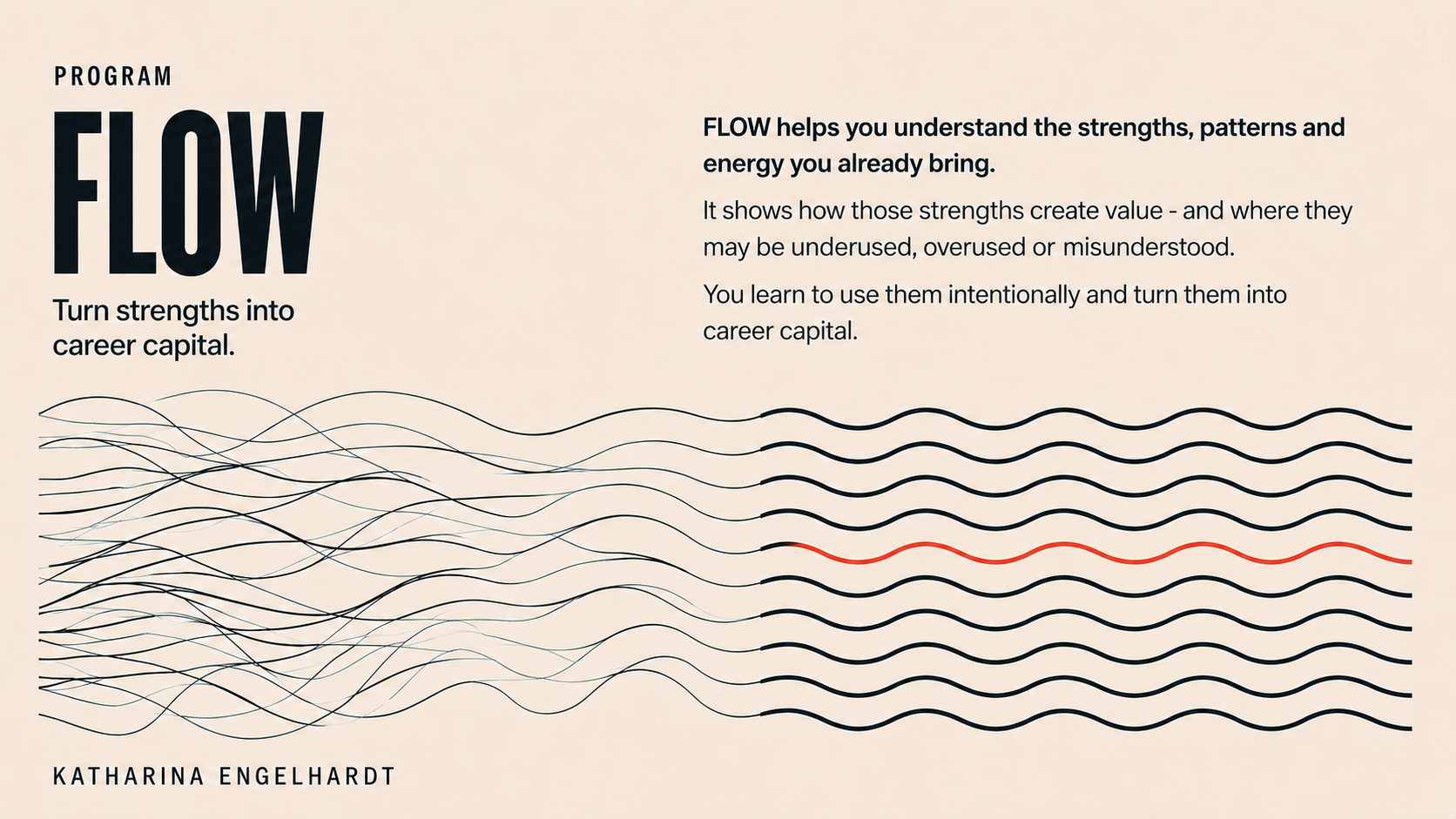
FLOW is the deeper space to understand your strengths and build a way of working that feels more natural, visible and sustainable.
We do not stop at reading a profile; we work with your strengths in real situations, decisions, communication, visibility and energy.
The goal is to turn strengths from private insight into practical material for how you work, lead and shape what comes next.
Your strengths are material for what comes next
Your strengths are not your label. They are your material.
They can help you understand what gives you energy. They can help you translate your value. They can help you shape your role. They can help you become visible for the right things. They can help you build skills that are actually rooted in who you are. They can help you lead without copying someone else's style. And they can help you prepare for a future that will not wait until your calendar is finally calm.
That is why strengths are not just self-discovery. They are future career capital. Not the whole answer. But a powerful place to start.
If this speaks to you
If this resonates and you want to explore what your strengths can become in your real role, book a Clarity Call here . You do not need to choose a programme before we speak. We can look at what is happening now, what kind of support may fit and what the next credible step could be.
If you are still circling, start gently with the Clarity Scan here. It can help you notice what feels true right now, what no longer fits, what keeps repeating and what may be asking for your attention next.
I am Katharina Engelhardt, founder of The Female Shift Atelier. I help high-achieving women shift from performing to leading - so success holds up over time and feels good.
Subscribe to my newsletter so you do not miss the next article in The Female Shift Journal here.
Stay courageous,
Katharina
It's in you!
Sources and further reading
Seligman, M. E. P. & Csikszentmihalyi, M. (2000): Positive Psychology: An Introduction. https://pubmed.ncbi.nlm.nih.gov/11392865/
Herminia Ibarra: Working Identity. https://herminiaibarra.com/working-identity-book/
World Economic Forum: The Future of Jobs Report 2025. https://www.weforum.org/publications/the-future-of-jobs-report-2025/
LinkedIn Learning: Workplace Learning Report 2025. https://learning.linkedin.com/resources/workplace-learning-report
Gallup: Learn About the History of CliftonStrengths. https://www.gallup.com/cliftonstrengths/en/253754/history-cliftonstrengths.aspx
Gallup: What Are the 34 CliftonStrengths Themes? https://www.gallup.com/cliftonstrengths/en/253715/34-cliftonstrengths-themes.aspx
Katharina Engelhardt: The Strengths SHIFT: Why Your Strengths Are Career Capital, Not Self-Discovery Fluff. https://www.katharinaengelhardt.com/blog/strengths-shift-career-capital-flow-visibility
Katharina Engelhardt: The Mixer-Board SHIFT: Which Strength Is Too Loud, Which One Needs More Space? https://www.katharinaengelhardt.com/blog/mixer-board-shift-lead-your-strengths-at-work
Pin this graphic if you liked the post.
Kathrina Engelhardt shares strategic questions female leaders should ask more often