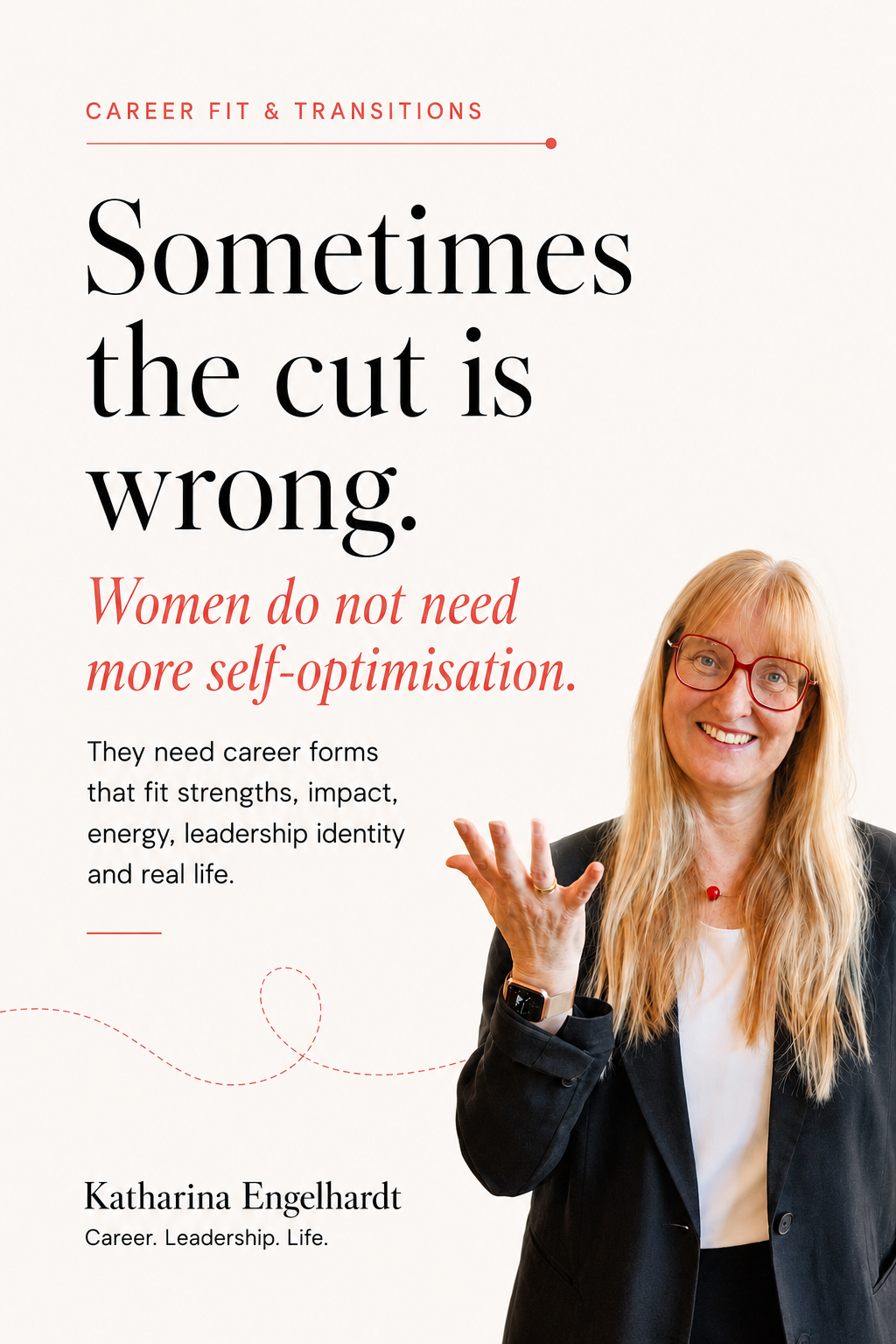
Why Women Do Not Need More Self-Optimisation But Careers That Fit
When a woman starts questioning her career, the first answer she usually gets is about herself. She should become more confident. More visible. More strategic. More resilient. Better at networking, clearer in her communication, stronger in her boundaries, sharper in her positioning, calmer under pressure and, ideally, still warm enough that nobody feels uncomfortable while she is finally taking up the space everyone told her to take.
Some of this advice is useful. I use some of it in my own work, because confidence matters, visibility matters, boundaries matter, language matters, and women do need tools to navigate the world they are working in.
But I have also become deeply sceptical of a career conversation that turns almost every problem women face into another development task for the woman. Because most often the woman is not the problem. Sometimes the cut is wrong.
Sometimes the role is too narrow. Sometimes the mandate is foggy. Sometimes the sponsorship is missing. Sometimes the expectations are contradictory. Sometimes the emotional labour is invisible. Sometimes the work is useful, but not promotable. Sometimes the woman is asked to become more resilient inside a system that keeps giving her responsibility without enough authority, visibility without enough protection and opportunity without enough runway.
And then we call it career development. I think we need a different conversation. Not one that asks, once again, how women can fit in better. But one that asks what career success could look like if we took new measure of strengths, impact, visibility, energy, leadership identity and the real life a woman is living while she is building all of this.
The glass cliff is one visible edge of a wider pattern
In my article on the glass cliff, I looked at a pattern that has become increasingly important in conversations about women and leadership: Women are often appointed into leadership roles when the situation is already unstable, risky or in decline.
That topic matters because it reminds us that progress is never only about who gets the role. It is also about the conditions under which she is expected to succeed. But the glass cliff is not the whole story. It is one visible edge of a wider pattern.
Again and again, women are asked to prove themselves inside structures that do not offer equal sponsorship, equal clarity, equal runway or equal protection. Sometimes they are brought in when the crisis has already started. Sometimes they are trusted with repair but not equally trusted with expansion. Sometimes they are praised for being reliable but not selected for power. Sometimes they are invited to lead, but only after the role has become politically difficult, emotionally loaded or operationally under-resourced.
And sometimes this pattern starts much earlier, long before a woman reaches the top. It starts when she becomes the person who always holds the team together. It starts when she is respected but not advocated for. It starts when she gets excellent feedback but remains somehow not quite ready. It starts when her clarity gets called difficult, while someone else’s sharpness gets called strategic. It starts when she is doing the invisible stitching of the organisation, while someone else is presenting the finished garment.
This is why I believe female careers need more than encouragement. They need a new cut.
The old career conversation asks women to adapt
Much of the traditional career conversation still begins with the same assumption: if something does not work, the woman must adjust.
If she is overlooked, she should become more visible.
If she is exhausted, she should become more resilient.
If she is not promoted, she should communicate her ambition better.
If she is not heard, she should speak with more confidence.
If she carries too much invisible work, she should set better boundaries.
If she is called difficult, she should adjust her tone.
If she is under-sponsored, she should network more.
If she is unsure what comes next, she should find her purpose.
Again, none of this is completely wrong. The problem is not that these ideas are useless. The problem is that they are incomplete. Because if we only ask women to adapt, we never ask what they are adapting to. We do not ask what kind of leadership model is still being rewarded. We do not ask who gets sponsored before they are fully ready and who has to prove themselves long after they are. We do not ask why some people are given stretch assignments with support, while others inherit repair work with applause. We do not ask why care, coordination, emotional intelligence and relational work are considered essential when missing, but often invisible when present. We do not ask why women’s ambition is so quickly questioned when the real issue may be that the available version of success has become too expensive.
A woman can be deeply committed to her career and still hesitate before stepping into the next role. Not because she lacks ambition. But because she has learned to read the pattern.
Many women are overfitted to usefulness
In my earlier career in textiles, product creation and apparel, fit was never decoration. Fit was structure. If something did not fit, we did not blame the body. We looked at the pattern, the fabric, the construction, the seam, the tension, the movement and the purpose of the garment. Careers deserve the same intelligence.
Many women in corporate environments have learned to fit into the system by becoming useful in very specific ways. They become the reliable one, the prepared one, the emotionally intelligent one, the one who sees the risks, the one who keeps things moving, the one who remembers the context, the one who translates between teams, the one who smooths the conflict, the one who delivers even when the mandate is unclear.
This creates value. Sometimes enormous value. But usefulness is not the same as authority.
A woman can become indispensable to a system and still not become influential in it. She can be trusted with complexity but not invited into the room where direction is shaped. She can be praised for her standards but not sponsored for the role. She can be known as the person who always delivers, while someone else becomes known as the person with leadership potential. This is where many careers become too tightly cut.
Not because the woman is too much, too little, too sensitive, too ambitious, too quiet or too reflective. But because the pattern rewards her for being useful while under-positioning her for power.
A career can look successful and still be too expensive
This is where psychology gives us better language.
People do not thrive only because they perform well. They also need autonomy, competence and relatedness. They need to feel that they have agency, that their capabilities are used and recognised, and that they can belong without constantly abandoning themselves.
That is why a career can look impressive from the outside and still feel deeply misaligned on the inside. A woman may be competent but not recognised for the contribution that matters most. She may belong, but only when she stays agreeable. She may have autonomy on paper, but little real decision power. She may be senior, but still over-managed by invisible expectations. She may be trusted, but mainly when she keeps absorbing pressure without naming it.
At some point, the question is no longer whether she can handle more. The question is what this version of success is asking her to trade. Her energy. Her health. Her voice. Her clarity. Her joy. Her relationship with her own life. And when the price becomes too high, I do not believe the answer is simply more resilience. Sometimes the answer is to look at the cut.
Women are already crafting their jobs just not always for themselves
There is a beautiful idea in organisational psychology called job crafting. It describes how people actively shape the task, relational and cognitive boundaries of their work. In other words, people are not only passive recipients of a job description. They shape how they work, whom they work with, what they focus on and how they understand the meaning of what they do.
I like this idea because it gives people agency. But with women’s careers, there is an important tension. Many women are already crafting their jobs all the time. They are just often crafting them around other people’s needs.
They adjust. They absorb. They translate. They coordinate. They repair. They support. They soften. They remember. They make things work. They expand the role quietly, but not always strategically. They add invisible value, but not always visible authority. They stretch the garment until it somehow fits everybody else, and then wonder why it no longer fits them.
That is why the new career conversation cannot simply be: Craft your job.
It needs to be more precise. Craft your role around your strengths, not only around the organisation’s gaps. Craft your visibility around your value, not only around your output. Craft your boundaries around your energy, not only around other people’s urgency. Craft your leadership identity around your authority, not only around your usefulness. Otherwise, job crafting becomes just another elegant name for doing more.
Energy is not a private weakness
The same is true for energy. Too often, energy is treated as a private issue. If a woman is exhausted, the answer becomes sleep, yoga, breathing, better routines, better boundaries or another productivity system with a calm font and a suspiciously beige colour palette.
Some of that can help. I like a good routine. I also like sleep. And I am certainly not campaigning against breathing. But exhaustion is not always an individual failure. Sometimes it is a design problem.
Many leadership roles come with high demands and insufficient resources. High expectations, but unclear mandate. High emotional labour, but low recognition. High visibility, but low protection. High responsibility, but limited decision rights. High complexity, but little sponsorship. High availability, but little recovery.
If a role demands everything and resources too little, the question is not whether the woman is resilient enough. The question is whether the role is designed well enough for sustainable leadership. This is why I no longer believe in success that only looks good from the outside. If success costs a woman her energy, health, identity, relationships or relationship with her own life, the cut is wrong.
The system also reads women differently
Any honest conversation about female careers must also speak about how leadership is interpreted. Women do not simply walk into neutral rooms. They walk into rooms with expectations. Expectations about warmth, authority, ambition, likability, care, strength, tone, motherhood, availability, age, confidence and leadership presence.
Be decisive, but not too hard. Be warm, but not too soft. Be visible, but not self-promotional. Be ambitious, but not threatening. Be clear, but not difficult. Be collaborative, but still executive. Be confident, but never arrogant. Be yourself, but preferably a version that does not disturb the seating plan.
When the pattern is contradictory, the solution cannot only be better self-presentation. Sometimes the pattern itself needs to be questioned. This is why I am careful with advice like “just be more visible” or “just speak up.” For many women, visibility is not neutral. Clarity is not neutral. Ambition is not neutral. Authority is not neutral. The same behaviour can be read differently depending on who performs it.
That does not mean women should stay quiet. Quite the opposite. It means we need to prepare women more strategically, while also naming the structures that make strategy necessary in the first place.
So what is the alternative?
The alternative is not to stop developing. Growth matters. Reflection matters. Coaching matters. Communication matters. Confidence matters. Visibility matters. But these things should not be taught as ways to make women more acceptable to outdated systems.
They should help women become clearer about their value, more intentional about their choices and more courageous in shaping the conditions under which they can lead well. For me, the new career conversation starts with six questions.
What are the strengths and experiences I am working with?
What value do I create beyond being reliable, helpful or busy?
Who needs to understand that value for my career to move?
What gives me energy, and what quietly drains the life out of my ambition?
What role conditions do I need in order to succeed, not just survive?
Where do I need to stop only supporting and start shaping?
These questions are simple, but they are not small. They shift the conversation from self-optimisation to strategic career design. They also prevent women from treating every mismatch as a personal weakness. Sometimes the role needs to be negotiated. Sometimes the visibility strategy needs to change. Sometimes the mandate needs to be clarified. Sometimes the invisible work needs to be named. Sometimes the next step is not the next title, but a better fit. Sometimes the woman does not need to become more resilient. She needs better resources. Sometimes the breakthrough is not to squeeze harder into the old pattern. Sometimes the breakthrough is to realise that the pattern was too narrow.
How I help women take new measure
This is where my work begins. I help women stop treating every career friction as a personal flaw and start looking at the full pattern: Their strengths, their value, their visibility, their energy, their leadership identity and the system they are moving through.
Sometimes that means clarifying what they want to be known for. Sometimes it means translating strengths into a stronger leadership narrative. Sometimes it means preparing a difficult conversation, auditing a role before saying yes, or noticing where performance has become a substitute for authority. Sometimes it means looking honestly at the price of ambition and designing success in a way that does not require self-abandonment as the entry ticket.
My work is not about helping women squeeze themselves more elegantly into old career patterns. It is about helping them take new measure.
Through the Strength Sprint, we look at the material: Strengths, patterns, energy and the value that is already there, but not always visible enough.
Through CREATE, we work on career direction, positioning, confidence, visibility and the next version of success.
Through SHIFT, we focus on sustainable high performance: Clarity, energy, courage, productivity, influence and the inner architecture needed to lead without losing yourself.
And in leadership transitions or organisational work, we look not only at the woman, but also at the role, the mandate, the sponsors, the politics, the decision rights, the team dynamics and the conditions for real impact. Because a career that fits is not a smaller career. It is a more precise one.
The Female Shift Atelier
The Female Shift Atelier is my way of holding this different career conversation. Not career development from the rack. Not another checklist for becoming more polished. Not empowerment wallpaper. Not a place where women are told to shrink, smooth themselves out or become endlessly adaptable to expectations that no longer deserve their adaptation.
It is a space to look at the cut. The woman. The role. The system. The strengths. The energy. The visibility. The ambition. The real life. The next version of leadership.
Because the future of female career development is not more fitting in. It is a better fit. And sometimes the most powerful sentence a woman can say in her career is not, “I will try harder.”
Sometimes it is: This does not fit anymore. Let’s take new measure. Let’s cut differently.
Want to explore what this means for your own career?
If this article touched something you recognise from your own career, this may be the right moment to stop solving it alone and look at the pattern more clearly. In my coaching work, I help women in corporate environments clarify their strengths, reposition their value, build visibility, navigate role decisions and design success in a way that fits their leadership identity and real life.
You can book a Discovery Call with me to explore which path fits best: Strength Sprint, CREATE, SHIFT or leadership transition coaching. Because your career does not need to be bigger at any cost. It needs to fit the woman you are becoming.
Sources
Katharina Engelhardt, The Glass Cliff Explained: Why Women Are Appointed to Lead in Crisis
McKinsey & LeanIn.Org, Women in the Workplace 2025
Self-Determination Theory, Basic Psychological Needs
Amy Wrzesniewski & Jane E. Dutton, Crafting a Job: Revisioning Employees as Active Crafters of Their Work
Demerouti, Bakker, Nachreiner & Schaufeli, The Job Demands–Resources Model of Burnout
Alice H. Eagly & Steven J. Karau, Role Congruity Theory of Prejudice Toward Female Leaders
World Economic Forum, The Future of Jobs Report 2025
Pin this graphic if you liked the post.