Not Every Promotion Is Progress
Why the Glass Cliff Shows That Access to Leadership Is Not Enough
"I finally got the role — but I inherited a mess."
I hear versions of this sentence often. Sometimes it comes with a small laugh, because the woman saying it still feels she should be grateful. Sometimes it comes with exhaustion, because the first weeks in the role already feel heavier than the title sounded. And sometimes it is said quietly, as if naming the truth would make her seem ungrateful or not quite ready for the opportunity she worked so hard to reach.
From the outside, the story looks simple. She got the role. She moved up. She has more visibility and finally has a seat at a table she was once told to wait for. People congratulate her, the announcement sounds polished, and the organisation may present the appointment as proof that things are changing.
Representation matters. Access matters. Women should be in the rooms where direction is shaped, money is allocated and futures are decided. But access is not the whole story. The more uncomfortable question is what women walk into once they arrive.
Inside the role, the shape of the opportunity can feel very different. The team is tired. The numbers are weak. The culture is tense. Stakeholders are sceptical. Expectations are high, resources are thin, and the mandate sounds ambitious in public but strangely unclear in private. The organisation wants change, but not necessarily the discomfort that change will create. Slowly, the woman realises that she has not only been promoted. She has inherited a situation.
Not every promotion is progress. Sometimes what looks like recognition is actually a transfer of risk.
The Glass Cliff Is About Conditions
Michelle Ryan and Alexander Haslam introduced the glass cliff in their 2005 research. The term describes a pattern in which women are more likely to reach leadership when an organisation is already performing poorly or facing a crisis. The glass ceiling keeps women out. The glass cliff lets them in when the ground is unstable.
That distinction matters because the glass cliff is not simply a story about access. It asks what conditions come with the opportunity. Is the organisation ready to share power, or has the situation become difficult enough that the risk is easier to hand over?
Research by Alison Cook and Christy Glass found that occupational minorities, including white women and racial and ethnic minority men and women, were more likely than white men to be promoted to CEO in weakly performing firms. Their later research examined the challenges women face above the glass ceiling, including scrutiny, legitimacy and access to the support needed to accomplish strategic goals. A review of a decade of glass-cliff research also found evidence across organisational and political settings, while showing that the pattern depends on context.
The issue is not that women cannot lead in difficult moments. Many can and do. The issue is that difficult roles are not neutral. They come with history, politics, broken trust, hidden resistance and decisions made long before the new leader arrives. A woman may step into what looks like an advancement while the organisation quietly hands her the unpaid invoice of past neglect.
Not every difficult or under-resourced promotion is a glass cliff. The term describes a recurring pattern, not a label for every messy transition. But it gives us a useful lens: a leadership opportunity cannot be judged by title and visibility alone. We also have to examine the mandate, authority, resources, sponsorship and runway attached to it. The role audit later in this article is my practical extension of that insight.
Across more than three decades inside international corporate organisations, I have seen how often the real mandate of a role becomes visible only after the appointment. The title is clear. The conditions are not.
When Structural Risk Becomes Personal
Visibility is not the same as support. A title is not the same as power. Recognition is not the same as a mandate.
A woman can be given responsibility without real decision rights. She can be asked to rebuild trust while the people who damaged it remain influential. She can be told to change the culture while still being expected to keep everyone comfortable. She can be appointed to lead a turnaround and judged against timelines that would be ambitious even in a healthy system.
She may inherit a team that has stopped trusting leadership because promises were made and not kept. She may inherit an unclear strategy, political tension, weak processes, underinvestment or a business problem that everyone knows about but no one has been willing to name directly. None of this appears in the celebratory announcement, but all of it shapes what she can achieve.
The person may be capable. The role may be poorly scoped. The system may be unwilling to name what it is handing over. Keeping those three levels separate matters because otherwise structural difficulty is quickly turned into an individual verdict.
Once she enters the role, the clock starts. Senior leaders want reassurance. The team wants clarity. Peers want collaboration. Critics want proof. She wants to show that the trust placed in her was justified. So she begins to carry the work and the context around the work: repairing relationships, absorbing emotion, translating between stakeholders, protecting the team and managing perception.
If results do not improve fast enough, the story can shift. The inherited mess becomes her leadership problem. Missing resources become her prioritisation issue. Stakeholder resistance becomes her communication gap. An unrealistic timeline becomes evidence that she cannot create traction. Structural risk has become personal evaluation.
The risk is not distributed equally. Catalyst's 2024 explainer highlights how gender and race can compound glass-cliff dynamics for women of colour. A woman may be expected to repair the business and, at the same time, prove that someone like her belonged in the role. When things become difficult, the benefit of the doubt is not always shared equally.
Ask Whether the Role Is Ready
The usual career conversation asks whether the woman is ready. Is she confident enough? Can she handle pressure? Can she lead through complexity and influence senior stakeholders? These questions are relevant, but they are incomplete.
Before we ask whether a woman is ready for the role, we should ask whether the role is ready for her to succeed.
A useful role audit looks beyond the job description and examines the conditions around it:
· What is the real mandate, and which decisions will actually be mine?
· What is already broken, and what has been tried before I arrive?
· Who wants me in this role, and who will support me when resistance appears?
· Which resources, decision rights and relationships come with the responsibility?
· What will success mean after 90, 180 and 365 days?
· What am I expected to repair that others were unable or unwilling to fix?
· What would make this role sustainable, not simply impressive?
These questions are not signs of fear. They are leadership due diligence. They help a woman distinguish a demanding opportunity from a poorly designed transfer of accountability.
This matters because many women have learned to respond to opportunity with gratitude first and scrutiny later. They do not want to seem difficult or ungrateful, especially when others already describe the role as a breakthrough. But gratitude is not a strategy.
A difficult role can still be the right role. Some of the most meaningful leadership opportunities involve uncertainty, resistance and repair. The question is whether the difficulty is named and whether the woman has enough authority and support to work with it.
A challenge comes with difficulty and support. A setup comes with difficulty and denial.
Women do not need to avoid risk. They need to understand which risks are shared, which are hidden and which are being handed to them without enough authority to manage them. A role audit does not make a woman difficult. It makes her strategic.
Difficult Roles Still Need Infrastructure
Every new senior leader has to build credibility, understand informal power, clarify expectations, read the culture and decide where to create early momentum. She must learn what has been said, what has remained unsaid, who is waiting, who is sceptical and who has already made up their mind. That is a demanding transition before the inherited business problem is added.
Leadership transitions are fragile even in good conditions. In a 2017 Harvard Business Review article, Ron Carucci reported that 61 percent of executives in a ten-year study by his firm said they had not been prepared for the strategic challenges they faced when appointed to senior leadership roles. The practical point is clear: a new title does not create transition readiness.
A high-risk role combined with a high-risk transition does not create a fair test of leadership. It makes personal capability and structural difficulty hard to separate. This is why transition support matters. It is not handholding. It is part of the infrastructure required for a complex role.
For the woman, that infrastructure can include mandate negotiation, stakeholder mapping, an early influence strategy, realistic success criteria and a clear view of what she can repair, what she needs to protect and what she cannot fix alone.
For the organisation, it starts with honest role scoping. What is the actual state of the business, team or function? What has failed? What is politically sensitive? Which decisions will the new leader be allowed to make? Where will she have backing, and where will she not?
It also requires active sponsorship. Warm encouragement on the day of the announcement is not enough. A sponsor uses influence when resistance appears, supports difficult decisions and helps protect the mandate. Success criteria must reflect the inherited conditions rather than pretending that years of underinvestment can be repaired within one quarter.
Deliberate onboarding and transition coaching also matter. An operational handover may explain the calendar, the budget and the reporting lines. It rarely prepares a leader for the identity shift, stakeholder dynamics and political choices that come with a visible role. Those are not soft extras. They affect whether authority can be built and used.
Appointing a woman is not the same as enabling her. Representation becomes progress only when the conditions around the appointment allow her to lead.
This Is Where the Female Shift Begins
Naming the system does not remove a woman's agency. It gives her better information. She can ask sharper questions, negotiate conditions, decide which risks are worth taking and recognise which risks are simply being transferred without enough authority to manage them.
I do not want women to be celebrated for stepping onto unstable ground and then blamed when it shifts. I want them to enter visible roles with clarity about the mandate, the stakeholder system, the support available and the transition ahead.
The future of women's leadership is not measured only by how many women reach bigger roles. It is also measured by how those roles are designed, how power is shared and whether success can hold up over time.
That is the Female Shift. It is not about fixing women so they can carry more brokenness with better posture. It is about changing how we assess roles, design transitions and define progress.
Explore Your Leadership Transition
If you are considering or entering a visible role and the conditions feel heavier than the title suggests, this may be the right moment to pause and examine the full transition. A Clarity Call can help you assess the mandate, map the stakeholder system and identify the support you would need to lead well. You can book a Clarity Call here .
Stay courageous,
Katharina
It's in you!
Sources
Ryan, M. K., and Haslam, S. A. (2005). The Glass Cliff: Evidence that Women Are Over-Represented in Precarious Leadership Positions. British Journal of Management, 16(2), 81–90. View source
Cook, A., and Glass, C. (2014). Above the Glass Ceiling: When Are Women and Racial and Ethnic Minorities Promoted to CEO? Strategic Management Journal, 35(7), 1080–1089. View source
Glass, C., and Cook, A. (2016). Leading at the Top: Understanding Women's Challenges above the Glass Ceiling. The Leadership Quarterly, 27(1), 51–63. View source
Ryan, M. K., Haslam, S. A., Morgenroth, T., Rink, F., Stoker, J., and Peters, K. (2016). Getting on Top of the Glass Cliff: Reviewing a Decade of Evidence, Explanations, and Impact. The Leadership Quarterly, 27(3), 446–455. View source
Catalyst. (2024). The Glass Cliff Phenomenon and Women of Color. View source
Carucci, R. (2017). Executives Fail to Execute Strategy Because They're Too Internally Focused. Harvard Business Review. View source
Pin this graphic if you liked the post.
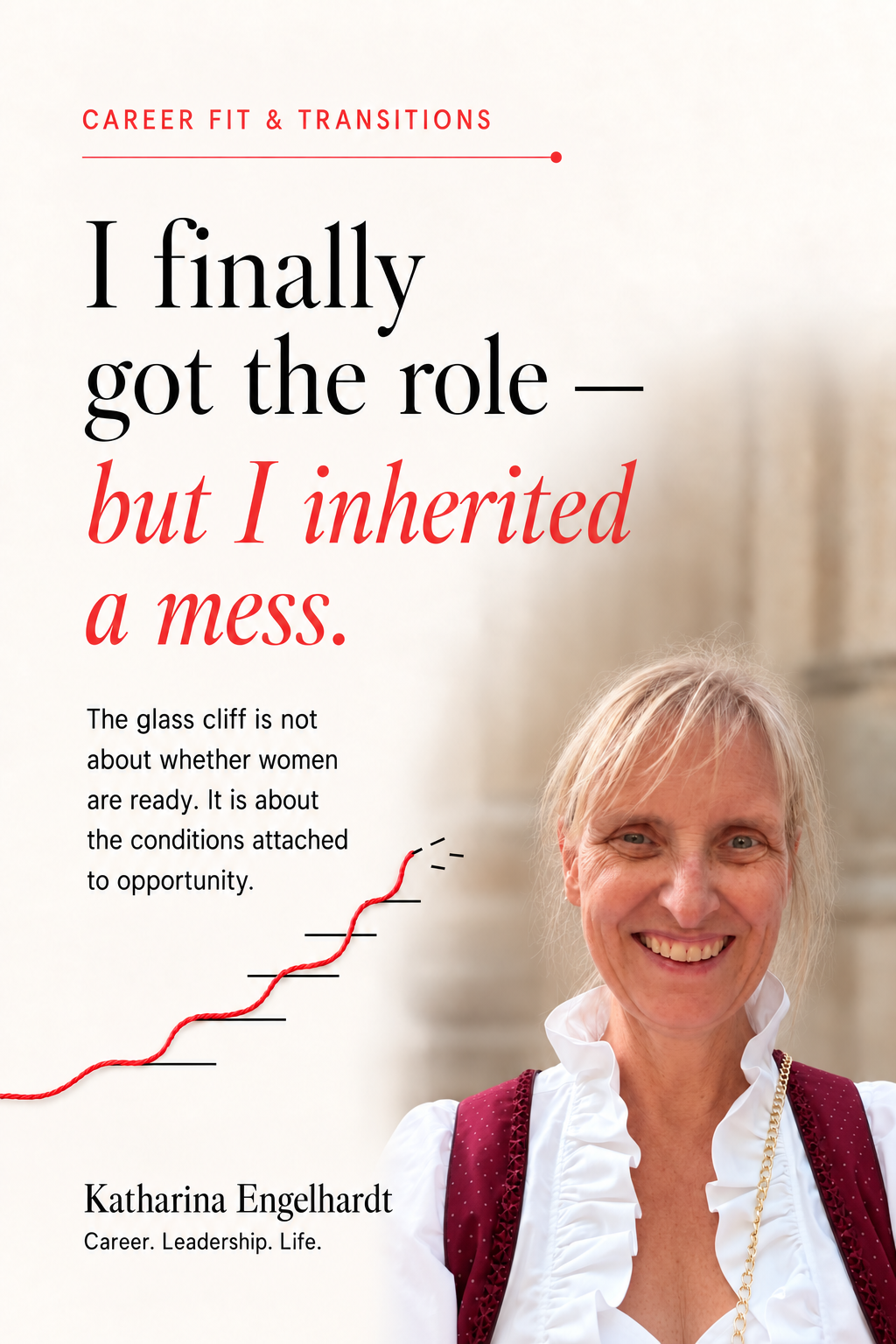
Kathrina Engelhardt shares strategic questions female leaders should ask more often
Explore my coaching.
Related posts: